-
Hay moisture meter | HayGuard
Regular price $149 USDRegular priceSale price $149 USD -
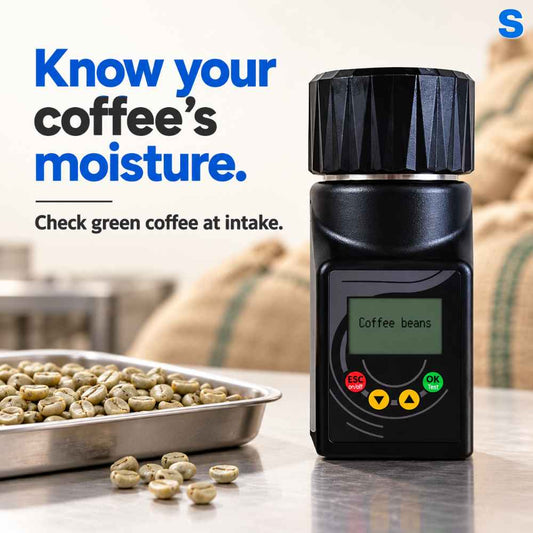
Coffee moisture meter | BeanCheck Pro
Regular price $399 USDRegular priceSale price $399 USD -
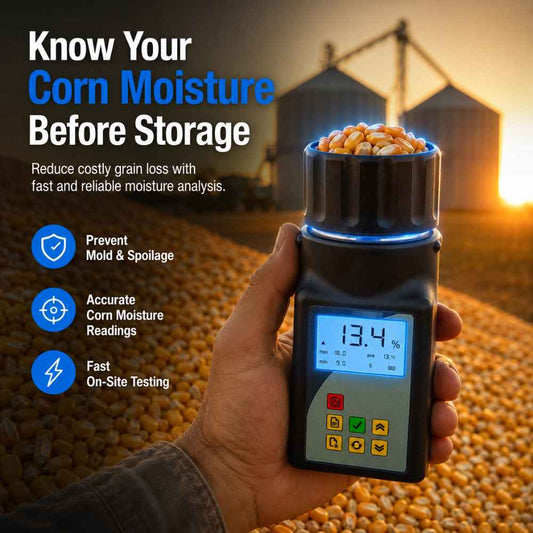
Moisture meter corn | CornGuard
Regular price $299 USDRegular priceSale price $299 USD
Grain Moisture Meter
SensoraHome · Grain & agricultural testing
Find a grain moisture meter that fits the crops you handle and the way you sample them. Start with a chamber-based tester for loose grains such as corn and wheat, then compare crop settings and reading functions. For coffee or baled hay, choose an instrument suited to that material. Explore the options below to narrow your choice before checking the full specifications on each product page.
Choose a moisture meter for your crop
A grain moisture tester measures moisture in a grain sample using a setting intended for that crop. The first buying decision is whether you need to test loose kernels, coffee samples, or forage inside a bale. Those applications call for different sample handling and material settings.
| What you test | Where to start | What matters when choosing |
|---|---|---|
| Loose corn and supported grains | Corn moisture meter | A chamber-based model with 25 grain and seed settings and sample averaging. Check the exact crop list before choosing it for a mixed-grain operation. |
| Coffee samples | Coffee moisture meter | A crop-specific option for coffee testing. Match the listed settings to your coffee's processing stage; a setting for one form does not establish compatibility with every other form. |
| Baled hay and forage | Hay moisture meter | A related agricultural instrument with long probes for checks within forage. Choose it for supported hay materials, rather than treating it as a substitute for a loose-grain sample chamber. |
Compare the features that affect your buying decision
Start with the crop list
For a wheat moisture meter, check that wheat is explicitly listed for the model. Apply the same check when choosing a barley moisture meter or soybean moisture meter. A large number of presets is useful only when it includes the crops and sample forms you actually handle.
Match the design to the material
A sample chamber suits loose grain that can be collected and loaded for testing. Long forage probes suit supported baled materials. Choose the format that fits your checks, whether you are comparing grain lots beside a truck or taking readings along a row of hay bales.
Look beyond the decimal place
Display resolution tells you the smallest increment shown on screen. Accuracy describes how closely a reading agrees with a reference under stated conditions. Compare the documented accuracy and measuring range for your crop, rather than judging an instrument by how many digits it displays.
Choose functions you will use
If you check several samples from a lot, averaging can make the results easier to review together. Grain-specific adjustment can help address a consistent difference from a reference instrument. When choosing a portable grain moisture meter, also consider loading, screen readability, and how often you will carry it between checks.
Buying for several crops? Make a shortlist of your materials first, then compare each product's supported settings. An agricultural moisture meter should fit your sampling routine as well as your crop list.
Questions to ask before choosing a grain moisture meter
Can I use one moisture meter across several crops?
Yes, when the instrument has a suitable setting for each crop and sample form. A multi-grain model can cover several jobs, but its preset count is not a substitute for checking the crop list. Confirm the exact materials you handle before selecting your meter.
Which design should I choose for loose grain versus hay?
Choose a grain-sample instrument for supported loose kernels and a forage-probe instrument for supported baled hay. The sample format is the key difference. If your operation handles both, selecting two purpose-suited meters may be more useful than expecting one design to cover every task.
What should I compare if I sell grain to an elevator?
Compare supported crops, documented accuracy conditions, and whether grain-specific adjustment is available. A handheld meter can help with checks before delivery, but it does not guarantee the same result as the elevator's instrument. Use the buyer's agreed testing method as the reference for acceptance.
Is a finer display resolution enough reason to upgrade?
No. Finer resolution is useful only alongside accuracy suited to your crop and working conditions. Before upgrading, compare sample handling, supported materials, and the functions missing from your current meter. A more readable screen or averaging function may matter more to your routine than another displayed decimal.
Start with your crop and sample type, then open the matching product page to review its specifications. Choose the meter that fits the checks you need to make, from loose grain samples to specialist coffee or forage testing.
Need a meter for another material? Explore our full range of moisture meters to find the right tool for your next job.