
Find Your Perfect Lumber Moisture Meter
3 quick questions — get a personalized recommendation from our full lineup.
What are you testing?
Can the meter leave small pin marks in the wood?
What's your budget?
-

 LIMITED OFFER
Moisture meter for home inspection | Heavy-duty
Regular price $99 USDRegular price$119 USDSale price $99 USDLIMITED OFFER -

 LIMITED OFFER
Pro Pinless moisture meter
Regular price $99 USDRegular price$119 USDSale price $99 USDLIMITED OFFER -

 LIMITED OFFER
Moisture meter for crawl space | CrawlGuard
Regular price $99 USDRegular price$119 USDSale price $99 USDLIMITED OFFER -

 LIMITED OFFER
Timber moisture meter | Pro Calibrated
Regular price $99 USDRegular price$119 USDSale price $99 USDLIMITED OFFER -
Pin moisture meter
Regular price $99 USDRegular price -
Moisture meter for subfloor | FloorGuard
Regular price $119 USDRegular price -
Moisture Meter for OSB | High-accuracy
Regular price $119 USDRegular price -
Hand held moisture meter | Calibrated
Regular price $119 USDRegular price$119 USDSale price $119 USD -
Pin type wood moisture meter | Pro
Regular price $79 USDRegular price -
Moisture meter for pressure treated wood
Regular price $139 USDRegular price


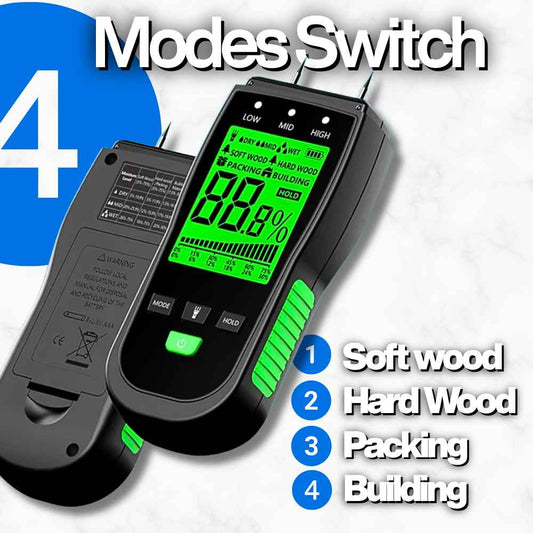

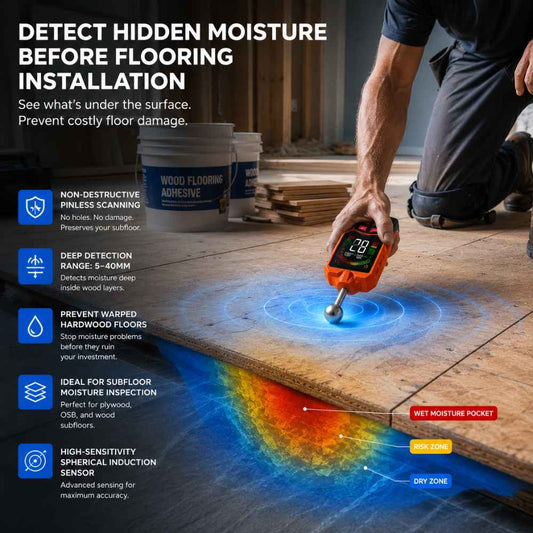

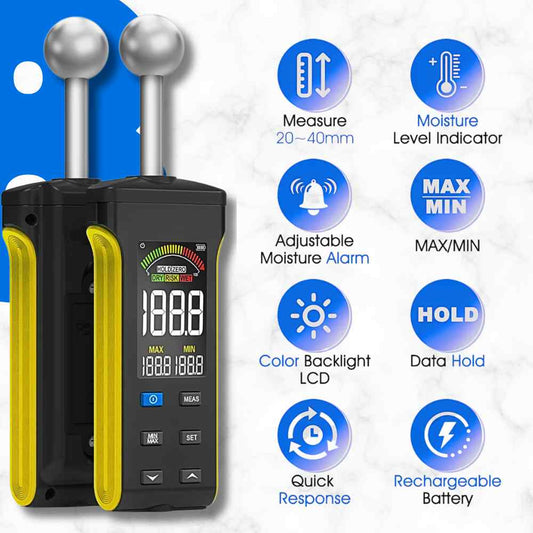



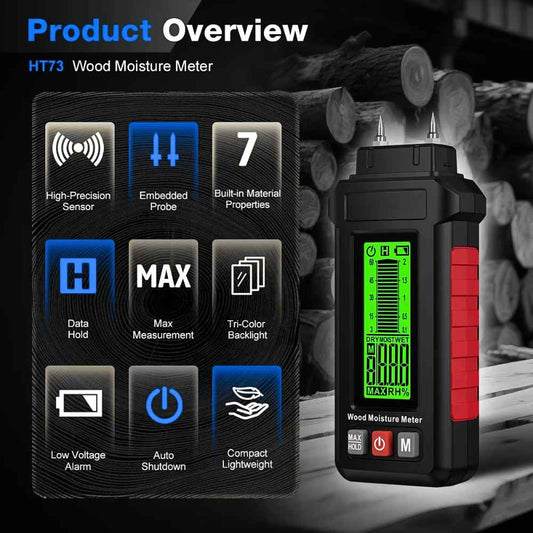


Lumber Moisture Meters for Framing, OSB Structural Wood:
Closing walls over damp framing is one of the most expensive mistakes on a residential build. IRC Section R319 caps framing lumber at 19% MC, exceed that threshold and you're looking at $4,000 to $22,000 in mold remediation and structural rework depending on the affected area. Dampness trapped inside a wooden assembly doesn't just disappear: it migrates, feeds mold colonies, and triggers the shrinkage that blows out your drywall joints. A lumber moisture meter built for jobsite conditions gives you that reading in seconds, before the drywall goes up.
Which type of lumber moisture meter do you need?
Pin-Type Meters, Framing, OSB, Green Lumber:
Pin meters drive a probe directly into the wood, giving you a reading at a defined depth, not just at the surface. On framing lumber, that distinction matters: surface MC can read dry while the core is still at 20%+. Pin readings are the accepted reference for IRC Section R319 compliance inspections and for field-verifying green lumber before enclosure. Use pin for studs, joists, rim boards, OSB subfloor panels, and plywood sheathing where inspectors need a documented, depth-verified measure.
You pull lumber off a flatbed in Phoenix in August. The surface reads 11.2%, but a pin probe reading at ¾" depth hits 17.8%, that's inside the wall before the framing has had any chance to dry. At that MC, you're sealing in humid conditions that produce active molded colonies within 30 to 90 days of enclosure.
Moisture Meters , Multi-Mode Available

Pinless Meters, Kiln-Dried Lumber, Laminated Beams, Large Surfaces
Pinless meters work as electromagnetic scanners across the wood surface without penetrating it. On kiln-dried lumber (6–9% MC), engineered beams, hardwood slabs, or finish-grade boards destined for woodworking and flooring applications where pin marks are unacceptable, pinless tools are faster and leave no trace. A woodsmith or woodworker handling finish lumber, LVT underlayment, or wide boards benefits from the scanning speed, but these meters are less accurate in wet or highly variable wood. Use pin for anything above 20% MC or when a compliance reading is required.
→ Full pin vs pinless comparison for all wood types
Lumber MC% Targets, Quick Reference:
| Lumber Type | Target MC% | Standard / Reference | Risk if Exceeded |
|---|---|---|---|
| Framing lumber (studs, joists) | ≤19% | IRC Section R319 | Mold, structural shrinkage |
| Kiln-dried lumber (interior finish) | 6–9% | NWFA / industry standard | Warping, joint failure |
| OSB / engineered subfloor panels | ≤16% | Manufacturer spec | Delamination, floor movement |
| Green lumber (rough framing) | 19–30% at delivery | USDA FPL Wood Handbook | Must dry before enclosure |
| Pressure-treated lumber | ≤19% before painting/finishing | Industry standard | Finish adhesion failure |
| Plywood sheathing / subfloor | ≤18% | APA / manufacturer spec | Delamination, damp-driven swelling |
| Hardwood flooring boards | 6–9% | NWFA installation guidelines | Gapping, cupping after drying |
Why a Lumber-Specific Meter, Not a Generalist Tool?
Wood is hygroscopic: it absorbs and releases water relative to ambient humidity, and the rate at which it does so varies significantly between softwood framing species and dense hardwood stock. A meter calibrated for structural lumber covers the 6–40% MC range that framing actually spans, from kiln-dried delivery stock to freshly milled green lumber still in active drying. Generalist hygrometers, data loggers, and finish-wood meters typically top out at 25–28%, which means they flat-line exactly where jobsite lumber most often falls. That's not a testing tool, that's a liability.
Species correction matters equally. Douglas Fir and Southern Yellow Pine, the two dominant softwood framing species in North American residential construction, have meaningfully different density and ion content. Professional-grade equipment from recognized lumber moisture tester manufacturers (Lignomat, Lignoversatec, and the Lignoscanner line are field benchmarks in this category) builds species correction tables directly into the meter's sensors. A tool without that adjustment introduces 3–4% systematic error on every measure. That's the difference between a pass and a hold on a code inspection. For woodwork and woodworking applications on non-structural wood, see our wood moisture meter for non-structural applications.
Buying Criteria of lumber moisture meter:
- Moisture range: Framing lumber can arrive above 30% MC; a meter capped at 25% gives you a flat line and useless scales when you need actual numbers in inches-deep wet stock.
- Species correction: Softwood species like Douglas Fir and Southern Yellow Pine require different correction factors built into the sensors; no adjustment means up to 4% error on every reading, which moves jobsite inspectors from pass to fail.
- Build quality: Jobsite equipment takes drops, dust, and temperature swings; look for IP-rated housing or reinforced construction, not consumer-grade plastic that fails before the framing is tested.
Lumber moisture meter FAQ:
What moisture content should lumber be before framing?
IRC Section R319 sets the maximum at 19% MC for framing lumber installed in walls and floors. Lumber above that threshold must dry before enclosure to prevent mold and structural shrinkage.
Do I need a pin or pinless meter for lumber?
For framing lumber, OSB, and green wood on a jobsite, use a pin meter , it reads at depth, not just at the surface, and is accepted as the reference for IRC compliance inspections. Pinless meters are better suited for large volumes of kiln-dried lumber or laminated beams where surface integrity must be preserved.
What's the moisture range I need for framing lumber vs kiln-dried?
Framing lumber must be at or below 19% MC before wall enclosure per IRC R319. Kiln-dried lumber for interior finish work should read 6–9% MC. A lumber moisture meter with a 6–40% range covers both scenarios.