
Find Your Perfect Wood Moisture Meter
3 quick questions — get a personalized recommendation from our full lineup.
What are you testing?
Can the meter leave small pinholes in the wood?
What's your budget?
-

 LIMITED OFFER
Firewood Moisture Meter Seasoning Checker
Regular price $69 USDRegular price$79 USDSale price $69 USDLIMITED OFFER -

 LIMITED OFFER
Pro Pinless moisture meter
Regular price $99 USDRegular price$119 USDSale price $99 USDLIMITED OFFER -
Walnut moisture meter | WalnutGuard
Regular price $89 USDRegular price -

 LIMITED OFFER
Moisture meter for wood flooring | Multi-Modes
Regular price $99 USDRegular price$119 USDSale price $99 USDLIMITED OFFER -

 LIMITED OFFER
Moisture meter for crawl space | CrawlGuard
Regular price $99 USDRegular price$119 USDSale price $99 USDLIMITED OFFER -
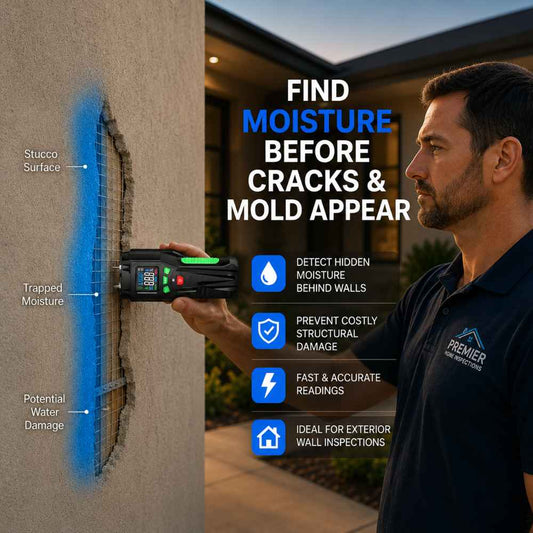
Stucco moisture meter | ProShield
Regular price $99 USDRegular price -
Oak moisture meter | Studio
Regular price $79 USDRegular price -
Moisture meter cedar | Field
Regular price $79 USDRegular price -
Furniture wood moisture meter
Regular price $89 USDRegular price -

 LIMITED OFFER
Timber moisture meter | Pro Calibrated
Regular price $99 USDRegular price$119 USDSale price $99 USDLIMITED OFFER -

 LIMITED OFFER
Hardwood moisture meter | Compact
Regular price $89 USDRegular price$99 USDSale price $89 USDLIMITED OFFER -
Woodworking moisture meter | Pro
Regular price $99 USDRegular price -
Bamboo moisture meter | FloorGuard
Regular price $89 USDRegular price -
Moisture meter for subfloor | FloorGuard
Regular price $119 USDRegular price -
Moisture meter for wood turning | Pro
Regular price $119 USDRegular price -
Moisture Meter for OSB | High-accuracy
Regular price $119 USDRegular price -
Pin pinless moisture meter | Handheld
Regular price $199 USDRegular price -
Moisture meter for pressure treated wood
Regular price $139 USDRegular price -
Digital wood moisture meter | Sensor
Regular price $79 USDRegular price -
Pin type wood moisture meter | Pro
Regular price $79 USDRegular price












Pin & Pinless Moisture Meter for Wood:
Whether you're laying hardwood floors, building furniture from raw stock, or burning firewood through a Colorado winter, the moisture content of your wood determines whether your project succeeds or fails. This collection brings together pin-type and pinless wood moisture meters selected for accuracy, durability, and real job-site reliability , from entry-level options for homeowners to professional instruments trusted by NWFA-certified flooring installers.
Every meter in this collection has been reviewed against NWFA installation standards and tested across common hardwood and softwood species.
Which Wood Moisture Meter Do You Need?
Three buyers. Three different needs. Here's the short answer before you browse:
| Your Situation | What You Need | Where to Start |
|---|---|---|
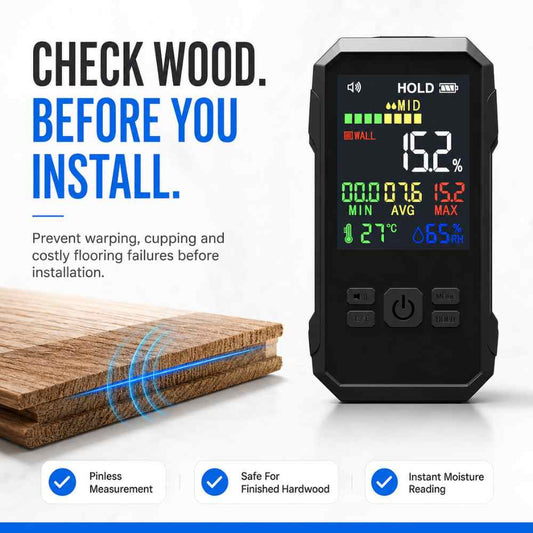
| Homeowner / DIY flooring installer , installing hardwood or engineered flooring in a conditioned space | Pinless meter: no surface damage on finished boards, fast screening across a full floor | Digital or Flooring model |
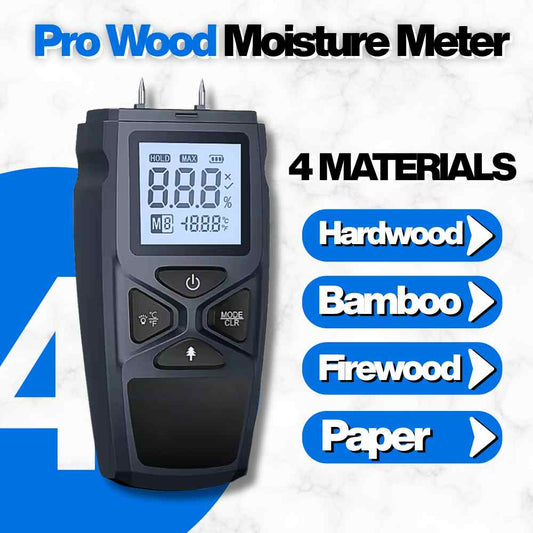
| Woodworking hobbyist / furniture maker , working with solid slabs, turning stock, or furniture-grade hardwood | Pin meter with species correction: precise spot readings, accurate on dense hardwoods, works on thick stock | Woodworking or Pin-type model |
| Flooring contractor / professional installer , managing multiple job sites, subfloor testing, warranty documentation | Both types: pinless for fast subfloor screening, pin with insulated deep-drive probes for confirmation readings and documentation | Flooring or Pressure Treated model |

Pin vs. Pinless Wood Moisture Meters: Which Type Fits Your Work?
The right meter type depends on your application , not personal preference. Here's the practical breakdown:
| Feature | Pin Meter | Pinless Meter |
|---|---|---|
| Measurement method | Electrical resistance between 2 probes inserted into wood | Electromagnetic scanning , no surface contact required |
| Typical depth range | Surface to ~1.5" (deeper with extended probes) | ~¾" to 1.5" depending on model |
| Ideal use case | Thick stock, framing, end-grain, precise spot readings | Finished surfaces, large-area screening, thin flooring stock |
| Surface impact | Two small pin holes per reading | Zero surface damage |
| Typical price range (US) | $44–$84 | $59–$89 |
| Species correction | Required , most meters factory-calibrated to Douglas fir | Required , same correction principle applies |
Pin meters deliver precise readings on thick or dense stock , the right call for walnut slabs, oak beams, or any wood over 1.5" thick. Pinless models cover ground fast without marking finished surfaces , the professional choice for subfloor screening before a flooring installation.
The NWFA standard for hardwood flooring installation is 6–9% MC. For framing lumber, IRC Section R319 sets the maximum at 19%. Your meter needs to read accurately within those ranges , not just provide a general ballpark.
Species correction matters: most meters are factory-calibrated to Douglas fir. Installing red oak, hard maple, or Southern yellow pine without adjusting the species setting produces readings that can be off by 1.5–2.5 points , enough to cause movement after installation. All meters in this collection include either a built-in species library or a manufacturer-supplied correction chart.

Key Features to Look For in a Wood Moisture Meter:
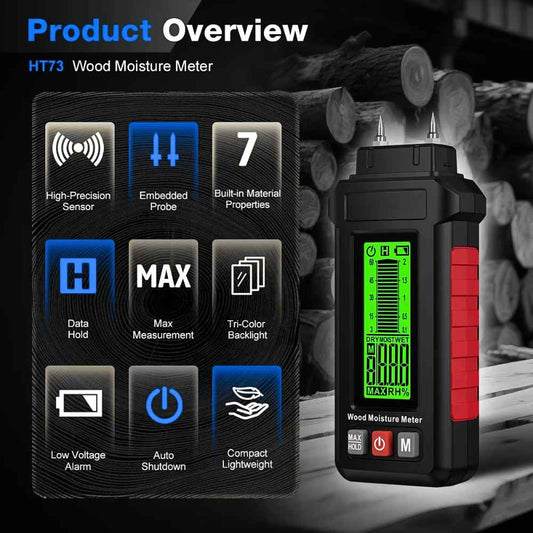
- Measurement range: A quality wood moisture meter reads from 5% to at least 50% MC. Anything below that range won't reliably detect wet framing or freshly cut firewood. If you're testing kiln-dried stock, confirm the low-end accuracy at 6–8% MC.
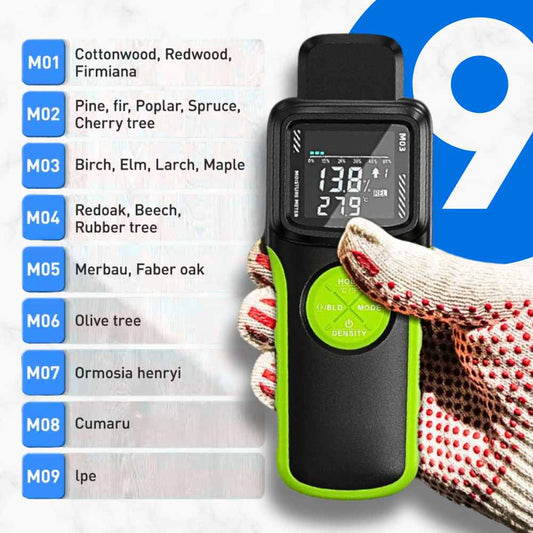
- Species correction settings: A built-in species library eliminates manual lookup and reduces error. Look for meters that include common hardwoods (oak, maple, cherry, walnut) and softwoods (pine, fir, cedar) as selectable profiles , not just a single default calibration.
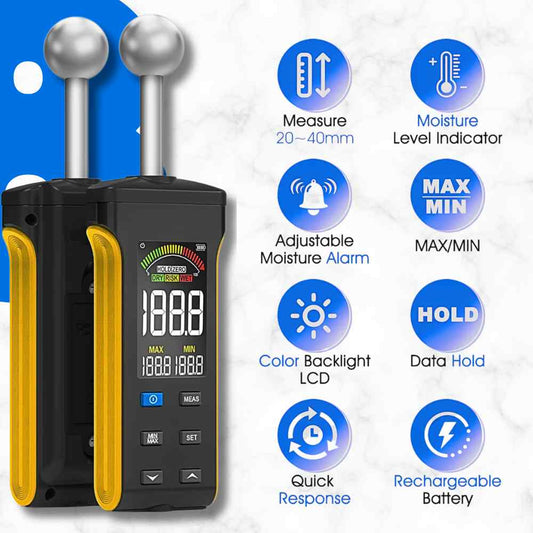
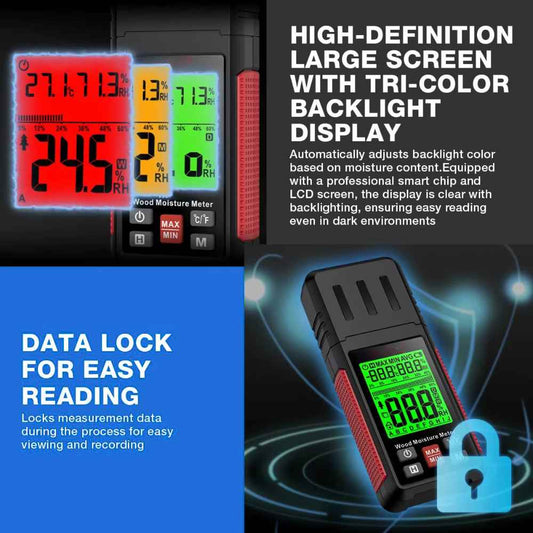
- Display readability: Backlit LCD displays matter on job sites in low light or direct sun. Readings should be large enough to confirm at a glance without squinting , seconds count when you're taking dozens of readings across a subfloor.
- Build durability for job-site use: Rubber overmolding, reinforced probe slots, and a protective carrying case are the difference between a meter that lasts one renovation and one that survives three years of contractor use. Check the drop rating and probe replacement policy before buying.
- Data hold / memory function: A hold function freezes the reading on screen after the probe is removed , essential when you're working in tight spaces or tracking readings across a large area. Memory function allows you to log multiple readings and compare across test points, which is required for NWFA documentation compliance.

Who Uses Wood Moisture Meters , And What They're Solving:
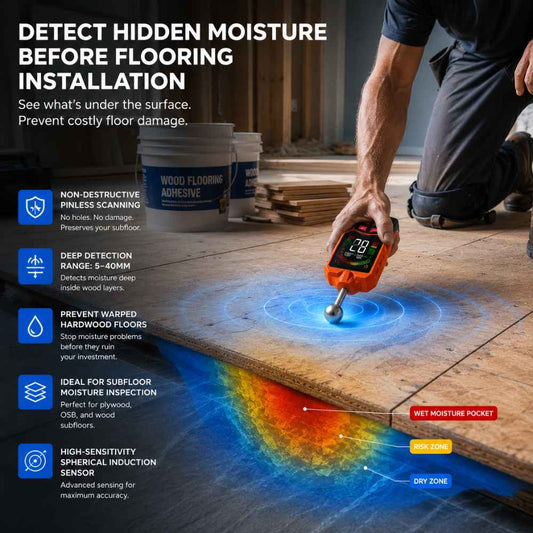
Hardwood flooring installation: Flooring that goes down at the wrong MC cups, gaps, or buckles within the first heating season. A moisture meter lets you verify that both the flooring and subfloor are within 2 percentage points of each other , the NWFA requirement that protects your warranty and your installation.
Woodworking and furniture making: Furniture-grade hardwood should sit between 6–8% MC before milling or joinery. Wet stock moves after the finish goes on. A pin meter with species correction gives you the precision needed to confirm your lumber is genuinely stable before committing it to a project.
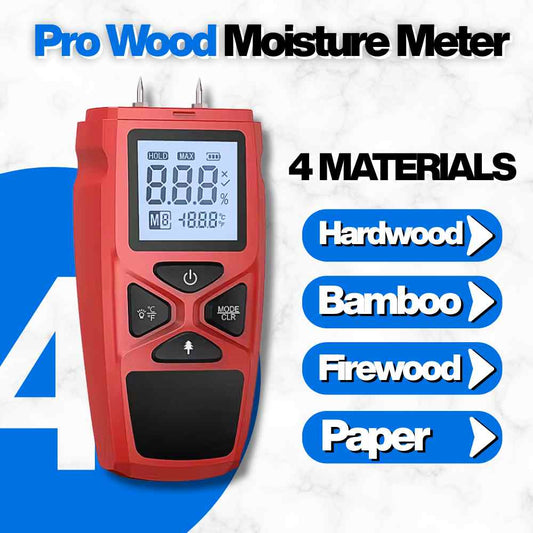
Firewood and wood drying: Firewood burns efficiently below 20% MC , above that threshold, you're losing BTUs to evaporation and building creosote. A basic pin meter takes the guesswork out of knowing when your stack is ready. How to test firewood correctly , including where to place the pins →
Lumber and construction framing: For framing, structural lumber, and pressure-treated materials, see our lumber moisture meter collection →
Standards Referenced in This Collection
- NWFA Installation Guidelines , 6–9% MC target for solid hardwood flooring; subfloor and flooring within 2 percentage points at installation. Full NWFA protocol →
- ASTM F2170 , In-situ relative humidity testing for concrete subfloors using probes embedded at 40% slab depth. Required by most hardwood flooring manufacturers before adhesive application. Subfloor testing protocol →
- IRC Section R319 , Maximum 19% MC for framing lumber at time of installation. See our lumber moisture meter collection for framing-specific tools.
Frequently Asked Questions , Wood Moisture Meters:
What is a good moisture reading for wood flooring?
The NWFA standard for hardwood flooring is 6–9% MC at installation. More specifically, the wood flooring and subfloor must read within 2 percentage points of each other , a flooring bundle at 7.5% over an OSB subfloor at 11% is not installation-ready, regardless of the flooring reading alone. In humid climates like Florida or the Gulf Coast, target the lower end of the range (6–7%) to leave room for seasonal moisture gain.
What's the difference between pin and pinless wood moisture meters?
Pin meters insert two probes into the wood and measure electrical resistance , more accurate on thick stock and dense species, but leave small holes. Pinless meters scan electromagnetically without surface contact , better for finished surfaces and fast screening of large areas. For a full side-by-side breakdown with a decision guide, see our complete pin vs. pinless comparison →
Do I need species correction on a wood moisture meter?
Yes, if you're working with anything other than Douglas fir or a similar softwood. Most meters are factory-calibrated to Douglas fir as a reference species. Hard maple, red oak, and walnut all read artificially low on fir calibration , errors of 1.5–2.5 points are common, which can make wet wood appear dry. Every meter in this collection includes species correction capability, either through a built-in library or a manufacturer correction table.
What moisture meter do flooring professionals use?
Professional installers typically use both types: a pinless meter for fast subfloor screening across large areas, and a pin meter with insulated deep-drive probes for precise confirmation readings and NWFA documentation. The two-meter workflow , scan with pinless, confirm with pin , is the job-site standard for installations where warranty documentation is required.
Collection last reviewed against NWFA guidelines and ASTM standards: February 2026.
Reviewed by Caleb Rowland : Certified Indoor Air Quality Specialist & Moisture Diagnostics Consultant | Updated: February 2026.
Still deciding which meter fits your project? Our complete wood moisture meter usage guide covers acclimation protocols, species correction, subfloor testing standards, and the five most costly measurement mistakes , all verified against current NWFA and ASTM guidelines.