Moisture meter for drywall, gypsum-calibrated instruments for contractors and inspectors:
Gypsum board retains moisture differently than wood, concrete, or masonry. A moisture meter for drywall that lacks a dedicated gypsum calibration mode does not produce valid diagnostic readings , it produces numbers with no actionable meaning. For water damage assessment, pre-close inspections, and flood remediation on 1/2" or 5/8" gypsum panels, the instrument you choose determines whether your findings hold up to IICRC S500 documentation requirements. The drywall moisture meters in this collection are selected for gypsum-specific calibration, appropriate pin depth, and field reliability under remediation conditions.
Why gypsum requires a dedicated calibration mode?
Calcium sulfate dihydrate , the core compound of gypsum board , has fundamentally different electrical resistance properties than wood fiber. A meter calibrated for wood applies species-based correction algorithms that are irrelevant to gypsum chemistry, producing readings that may be 40–60% off the actual MC%. The Gypsum Association GA-226 standard defines the reference calibration protocol for gypsum panel moisture content, specifying a measurement accuracy of ±2–3% MC under controlled conditions when a gypsum mode is active. For a detailed breakdown of why a wood-calibrated meter produces invalid readings on gypsum board, see our dedicated technical guide. Running a wood-mode reading on a saturated 5/8" Type X panel and acting on that number is not a diagnostic , it is a liability.
Drywall moisture thresholds for professionals:
These thresholds are derived from EPA mold guidance, IICRC S500 Standard for Professional Water Damage Restoration, and GA-226 documentation protocols. Use them as decision triggers, not as approximate benchmarks.
| Panel Condition |
MC% Gypsum |
Associated Risk |
Recommended Action |
| Dry / baseline |
0.2–0.5% |
None |
Document as acceptable; no intervention required |
| Elevated — alert threshold |
Above 1% / 48h+ |
Mold onset conditions per EPA guidance |
Begin drying protocol; re-read at 24h intervals; do not close |
| Active water intrusion |
4%+ |
Panel delamination risk; paper face saturation |
Immediate remediation; IICRC S500 Cat 2/3 classification triggers MC verification before closure |
| Saturated — post-flood |
8%+ |
Structural compromise; microbial colonization likely |
Full demo protocol; do not attempt drying; document with pin depth readings for insurance file |
Dry / baseline
MC% 0.2–0.5%
Risk: None
Action: Document as acceptable; no intervention required
Elevated — alert threshold
MC% Above 1% / 48h+
Risk: Mold onset conditions per EPA guidance
Action: Begin drying protocol; re-read at 24h intervals; do not close
Active water intrusion
MC% 4%+
Risk: Panel delamination risk; paper face saturation
Action: Immediate remediation; IICRC S500 Cat 2/3 classification triggers MC verification before closure
Saturated — post-flood
MC% 8%+
Risk: Structural compromise; microbial colonization likely
Action: Full demo protocol; do not attempt drying; document with pin depth readings for insurance file
You are on-site 36 hours after a supply line failure behind a 5/8" Type X gypsum wall in a commercial corridor. Your pin meter reads 3.8% MC at 3/4" depth. The paper face looks intact. Without that number, a visual inspection might pass the panel. With it, you have documented grounds for remediation , and you have shifted the liability away from your sign-off. Skipping the correct instrument on that call is how a contained repair becomes a $2,500–$18,000 post-remediation mold claim.
Pin vs. pinless for drywall assessment:
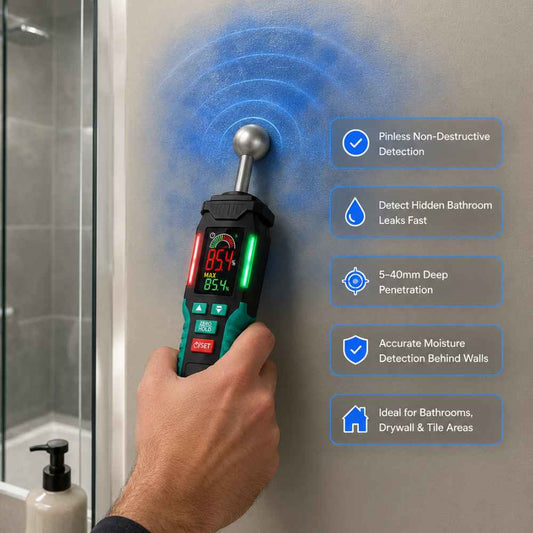
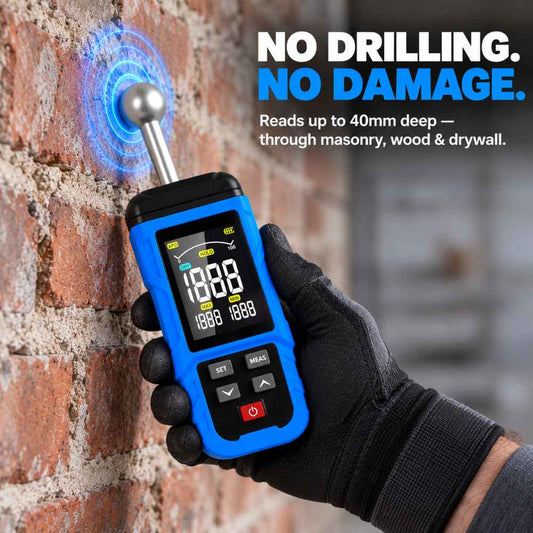
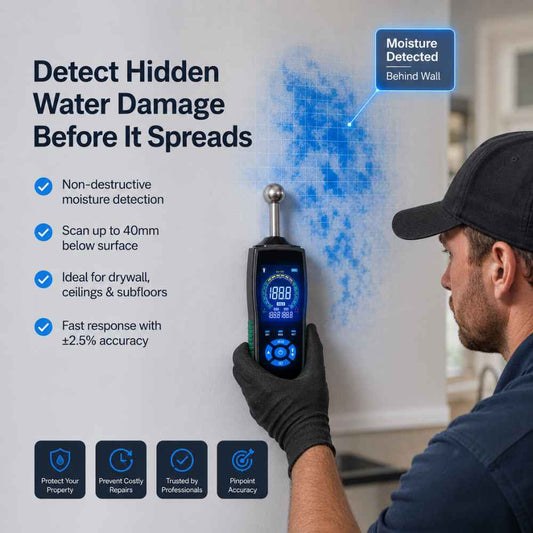
Both methods are used in professional gypsum moisture assessment. Neither replaces the other. The standard field workflow for large-scale water damage assessment uses pinless for initial screening across extended drywall runs, then pin meters to confirm depth and saturation level at flagged points. Do not use a pinless scan as your only documentation instrument on an IICRC S500 file.
| Method |
Reading Depth |
Primary Drywall Use |
Key Advantage |
Key Limitation |
|
Pin (invasive) |
Defined by pin length, minimum 3/4" for 5/8" panel core |
Confirm saturation depth; document for remediation files; cavity assessment with hammer probe |
Precise, depth-specific reading; required for IICRC S500 closure documentation |
Leaves pin marks; slower on large surfaces; not suitable for finished surfaces pre-litigation |
|
Pinless (non-invasive) |
Surface to ~3/4" electromagnetic field depth, varies by sensor |
Rapid triage across extended gypsum panel runs; identify saturation zones for follow-up pin testing |
Fast; no surface damage; covers high linear footage per minute |
Cannot confirm depth of saturation; requires calibration validation on gypsum; not standalone documentation |
Pin — Invasive
Reading depth: Defined by pin length, minimum 3/4" for 5/8" panel core
Primary use: Confirm saturation depth; document for remediation files; cavity assessment with hammer probe
Advantage: Precise, depth-specific reading; required for IICRC S500 closure documentation
Limitation: Leaves pin marks; slower on large surfaces; not suitable for finished surfaces pre-litigation
Pinless — Non-Invasive
Reading depth: Surface to ~3/4" electromagnetic field depth, varies by sensor
Primary use: Rapid triage across extended gypsum panel runs; identify saturation zones for follow-up pin testing
Advantage: Fast; no surface damage; covers high linear footage per minute
Limitation: Cannot confirm depth of saturation; requires calibration validation on gypsum; not standalone documentation
Choosing your drywall moisture meter:
Use these four criteria as a qualification checklist before ordering. Each maps directly to a failure mode you will encounter in the field.
-
1
Gypsum calibration mode (GA-226)
A meter without a dedicated gypsum mode , not a generic “reference mode,” but a mode explicitly aligned with GA-226 gypsum board calibration , cannot produce a defensible reading on drywall. If the product listing does not specify gypsum mode, assume it is not present.
-
2
Pin depth: minimum 3/4" for core access
Standard 5/8" Type X gypsum board requires pins that reach at least 3/4" to access the calcium sulfate core. Short fixed pins on 5/8" board read surface conditions only , useless in a water intrusion scenario.
-
3
Field legibility: backlit display, IP-rated housing
A meter that fogged up or failed on a wet-envelope job is not a tool , it is a paperweight. Backlit display and IP-rated housing are minimum requirements for remediation environments.
-
4
Accessory probe compatibility
A drywall moisture detector used with a hammer probe or deep wall electrode reads MC% inside gypsum panel cavities and behind drywall assemblies without full demolition , the difference between a targeted repair and an exploratory demo. If the meter does not support accessory probe attachment, it limits your assessment capability on cavity-adjacent gypsum panels. For moisture assessment on other substrates such as brick, concrete, or painted surfaces, see our full moisture meter collection.
Frequently asked questions for drywall:
What is the best moisture meter for drywall?
A pin-type drywall moisture meter with a dedicated gypsum calibration mode aligned to GA-226 is the professional standard. For water damage assessment and flood remediation, the meter must reach the panel core , meaning pin depth of at least 3/4" for 5/8" board , and produce readings in MC% gypsum, not wood-referenced values. Inspectors working IICRC S500 files require a pin meter that supports documentation of pre-close and post-drying readings. A pinless drywall moisture detector is a useful triage tool for large wall runs but does not replace pin confirmation for final sign-off.
What moisture level is too high for drywall?
Drywall MC above 1% sustained for 48 hours or more triggers mold onset conditions per EPA guidance. At 4%+ MC, panel delamination becomes a structural risk and IICRC S500 classifies the area as Category 2 or 3 water damage, requiring MC verification before wall closure. At 8%+ MC , typical in post-flood scenarios , full demo protocol applies; drying is not a viable remediation path. Normal baseline MC for dry gypsum board is 0.2–0.5%.
Can I use a pin moisture meter on drywall?
Yes , a pin-type meter with a dedicated gypsum calibration mode is the standard instrument for drywall water damage assessment. Pin depth must be sufficient to reach the panel core: minimum 3/4" for 5/8" Type X gypsum board. A reading is only valid if the gypsum mode is active , running pins into drywall with a wood-calibrated setting produces numbers that have no diagnostic value. For a full explanation of calibration requirements on gypsum substrates, see
why a wood-calibrated meter produces invalid readings on gypsum board.
What is the difference between a drywall moisture meter and a regular moisture meter?
The difference is calibration. A drywall moisture meter applies a gypsum-specific algorithm , defined by GA-226 , that accounts for the electrical resistance properties of calcium sulfate dihydrate. A standard moisture meter calibrated for wood applies species-correction factors that are scientifically irrelevant to gypsum board, producing MC% readings that can be off by 40–60% or more. On a remediation job or pre-close inspection, that gap between a real reading and a wood-mode artifact is the difference between a correct remediation scope and a missed moisture pocket that becomes a mold claim.


 LIMITED OFFER
 LIMITED OFFER
 LIMITED OFFER
 LIMITED OFFER
 LIMITED OFFER
 LIMITED OFFER
 LIMITED OFFER