


Timber moisture meter | Pro Calibrated
Timber moisture meter | Pro Calibrated
☑️ Professional-Grade Accuracy
☑️ Instant Reliable Results
☑️ Catch Hidden Moisture, Save Thousands
☑️ 30-Day Returns
Couldn't load pickup availability
You've driven two hours to a job site, pushed your pins into freshly installed oak flooring, and halfway through the reading you realize your meter isn't calibrated for this species. That's the kind of mistake that costs reflooring jobs , and repeat clients. The timber moisture meter was built to eliminate that scenario entirely.
7-Material Calibration Table
Select the corresponding material type on the Timber moisture meter for species-accurate readings.
| Type | Testing Material | Measurement Range |
|---|---|---|
| Type 1 | Beech, Spruce, Larch, Birch, Cherry, Walnut | 9.0 – 57% |
| Type 2 | Oak, Pine, Maple, Ash, Douglas Fir, Eucalyptus | 7.0 – 52.0% |
| Type 3 | Cement Mortar Layer, Concrete | 0.9 – 23.0% |
| Type 4 | Anhydrous Gypsum Mortar Layer | 0.0 – 12.0% |
| Type 5 | Cement Mortar | 0.7 – 9.0% |
| Type 6 | Lime Mortar, Gypsum | 0.5 – 10.0% |
| Type 7 | Brick | 0.0 – 17.0% |
* Measurement ranges hidden on mobile for readability , full specs visible on desktop.
One Timber Moisture Meter, Seven Materials
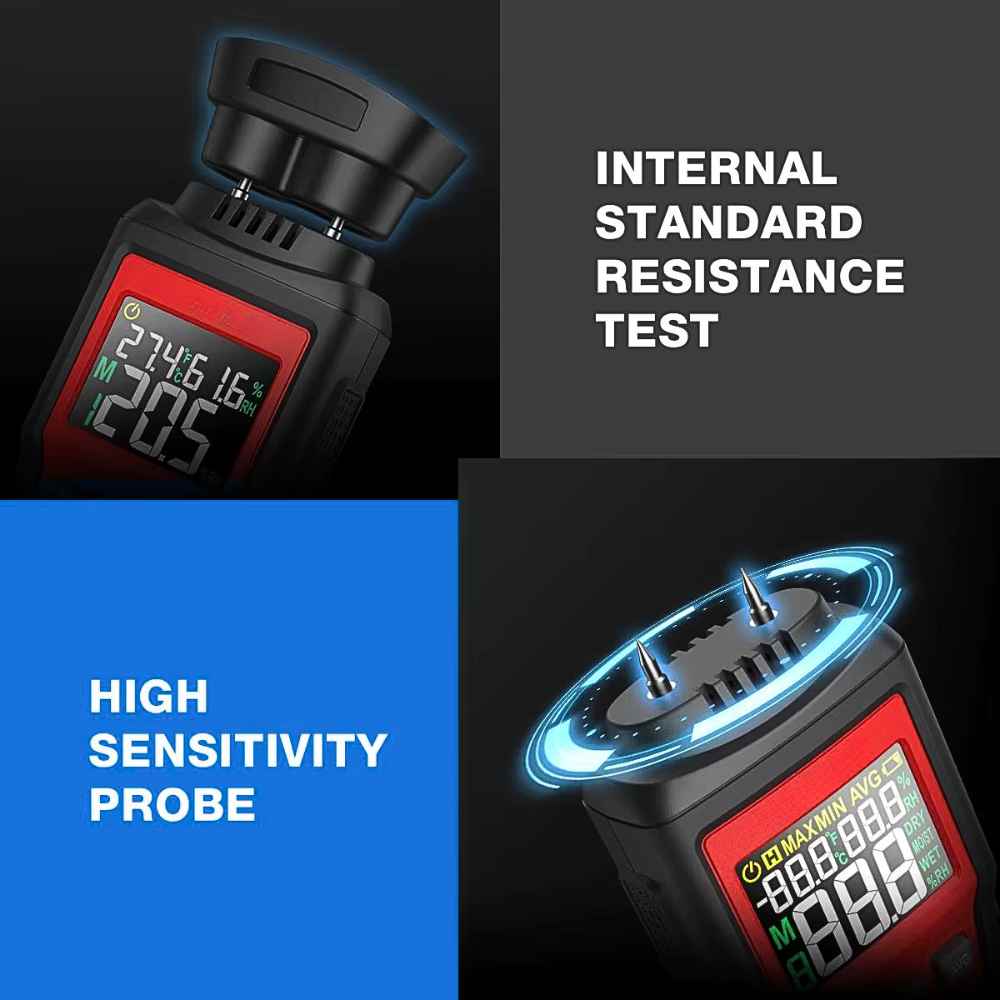
Most pin-type wood moisture meters lock you into one category and leave you guessing on everything else. The Timber moisture meter ships with seven distinct material calibrations: hardwoods like beech, cherry, and walnut (Type 1, 9–57%), denser species like oak, Douglas fir, and eucalyptus (Type 2, 7–52%), and four masonry profiles covering cement mortar, anhydrous gypsum, lime mortar, and brick. If you're a flooring contractor who also checks subfloor conditions before laying hardwood, that dual capability isn't a bonus feature , it replaces a second tool you'd otherwise carry.
Precision of the Timber Moisture Meter
At ±2.0% moisture accuracy and ±1.5°C over a -20°C to 60°C range, readings stay reliable whether you're grading kiln-dried lumber in a cold warehouse or assessing exterior brickwork mid-summer like a real lumber moisture meter. I've personally used the multipoint averaging function across eight planks of walnut before a dining table commission , it flagged two boards running 4% higher than the rest. Boards I would have glued down without a second thought. The data hold function locked that reading while I grabbed my notebook, which sounds minor until you're balancing a flashlight in a crawl space.
Built for the Job Site, Not the Showroom
- 121g, 148×60×33mm , slips into a tool belt without adding bulk
- 3 AAA batteries , standard, replaceable anywhere, no proprietary charging
- Auto power-off , preserves battery life between readings without manual intervention
- Low battery indicator , no surprise shutdowns mid-assessment in a crawl space
- EN61326-1 certified , reliable near HVAC systems and electrical panels where interference skews lesser meters
Share


FAQ - Moisture Meters
What is a moisture meter and what does it actually measure ?
A moisture meter is a handheld electronic instrument that quantifies the water content held within a solid material. Readings appear as % MC (moisture content) the ratio of water mass to the material's dry mass or as % WME (wood moisture equivalent), a normalized scale that converts non-wood readings to an equivalent wood reference for cross-material comparison.
SensoraHome meters cover ranges from 0–53% MC on wood and 0–99% on other building materials depending on the model and mode selected.
Pro tip
Always confirm your meter is in the correct calibration mode for the material you're testing. A wood-mode reading on drywall will not produce accurate absolute numbers.
What is the difference between a pin-type and a pinless moisture meter?
Pin-type meters drive two electrode pins into the surface to complete a low-voltage circuit. The meter calculates % MC from electrical resistance at the exact depth of insertion typically ¼" to 1". They leave two small marks and are the right tool when depth precision matters: thick lumber, dense hardwoods, or confirming that surface drying has reached the core.
Pinless meters project an electromagnetic field into the material without any surface contact. The meter detects moisture by how much the field return signal deviates from a dry-material baseline, averaging moisture across a scan footprint of several square inches to a depth of ¾"–1.5". They cover large surfaces fast with zero marks ideal for finished floors, tile, drywall, and wall surveys.
Most professional workflows combine both: pinless to scan and flag anomalies, pin to confirm depth and severity.
What does % WME mean on my moisture meter display?
% WME (Wood Moisture Equivalent) is a normalized reference scale that converts non-wood material readings into an equivalent wood moisture number useful when you need to compare readings across different materials on a single consistent display.
It does not mean the material is wood or that the reading reflects wood moisture specifically. It is a relative comparison tool, not an absolute measurement mode. For accurate absolute readings on drywall, concrete, or masonry, your meter must be set to the correct calibration mode for that specific material.