


Stucco moisture meter | ProShield
Stucco moisture meter | ProShield
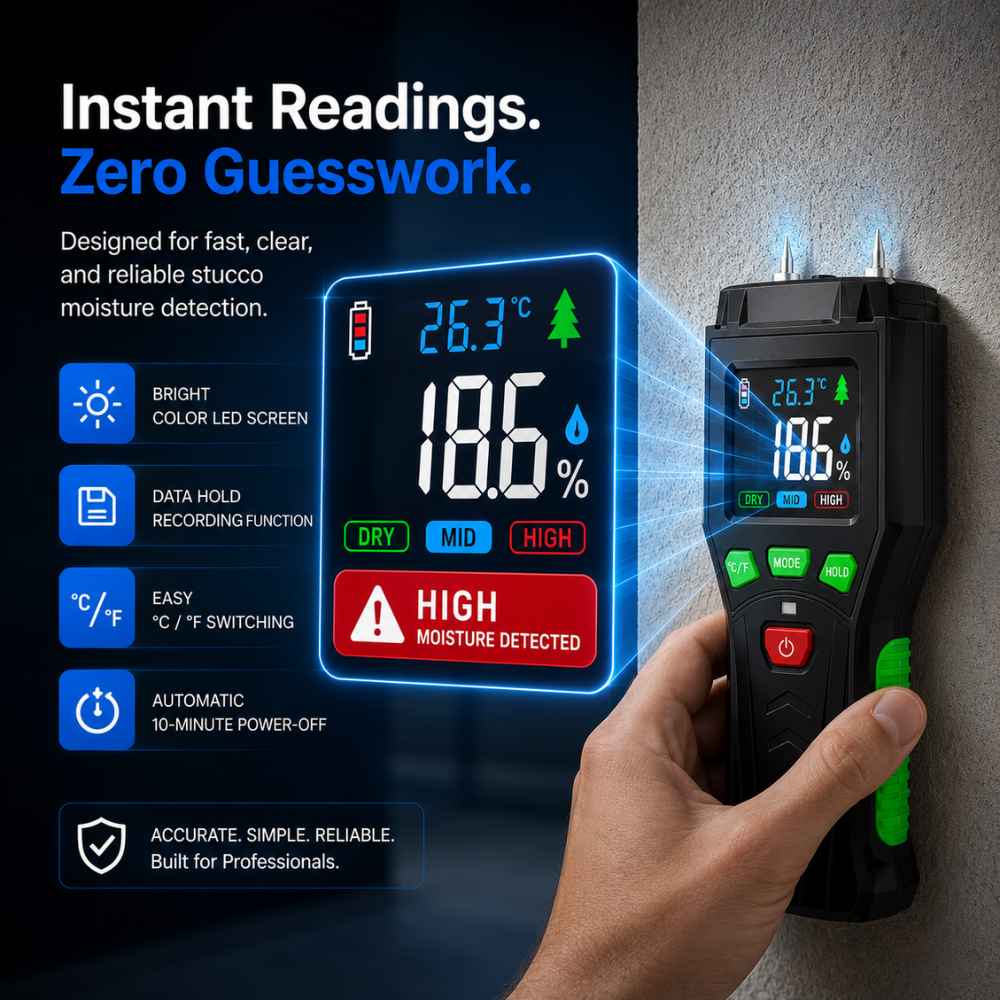
☑️ Professional-Grade Accuracy
☑️ Instant Reliable Results
☑️ Catch Hidden Moisture, Save Thousands
☑️ 30-Day Returns
Couldn't load pickup availability
What Trapped Moisture in Stucco Actually Costs Before You Catch It?
Stucco walls fail quietly. Water enters through micro-cracks, gets trapped between the cementitious layer and the weather-resistant barrier, and stays there for months before the first visible sign appears.
By the time a stain shows up on the interior or a section of the exterior starts to bulge, the damage has already migrated to the framing behind it. The cost at that point is no longer a patching job; it is a remediation.
A pin-probe stucco moisture meter changes that sequence entirely: you scan the wall on a routine basis, flag any zone reading above 16% in building materials mode, and schedule targeted repair before the water has time to wick laterally into structural members. That single shift in workflow is why inspectors and stucco contractors who adopt moisture metering as a standard practice stop writing damage reports after the fact and start writing prevention reports instead.
What the Color Alert Means on Stucco and Building Materials
- ● DRY (GREEN) — Building materials below 12% / Wood below 17%: No active moisture migration. Surface is within acceptable range for stucco finishing, flooring installation, or drywall closure.
- ● MID (BLUE) — Building materials 12%–16% / Wood 17%–20%: Moisture is present and should be monitored. Do not close or finish the surface until readings stabilize in the DRY zone across three consecutive weekly checks.
- ● HIGH (RED) — Building materials above 16% / Wood above 20%: Active moisture intrusion requiring immediate investigation. At this level, mold growth is probable within 24–72 hours in an enclosed cavity if the source is not addressed.
How the ProShield Pin Probe Reads Moisture Content in Stucco and Building Materials?
The ProShield measures moisture content across a range of 0 to 60%, using two replaceable hardened-steel pins that penetrate the material surface and complete a resistance circuit. In building materials mode (BLD), the meter classifies readings into three actionable zones: DRY below 12%, MID between 12% and 16%, and HIGH above 16%, displayed on a color LED screen that switches between green, blue, and red without requiring any interpretation from the user.
The sampling rate is 240 m/s with an LCD refresh cycle of 1.5 seconds, which means a reading stabilizes in under two seconds per test point. The meter also captures ambient temperature simultaneously in both Celsius and Fahrenheit, and the Data Hold function freezes the display so a reading can be logged on a clipboard or photographed without the screen refreshing.
On a stucco inspection involving 40 to 60 test points across a facade, that combination of speed and display clarity cuts documentation time by more than half compared to meters that require the user to interpret a raw percentage against a separate reference chart.
Moisture Level Reference — By Material Type
Source: ProShield display classification. Readings above the HIGH threshold in building materials (BLD) mode indicate active moisture intrusion requiring immediate inspection.
Where a Stucco Moisture Detector Catches What a Visual Inspection Misses?
The third time I walked a two-story stucco home that had passed its visual inspection, scanned the base of the window returns with the pin probe, and watched the display jump to HIGH at 19.4% on the BLD scale, I understood why remediation contractors always ask whether a meter was used at the time of purchase or sale.
The moisture was coming in through the window-to-stucco interface, not through a crack, and there was nothing on the surface to indicate it. The framing behind that section was already showing early-stage moisture staining when the contractor opened the wall two weeks later.
The ProShield reads building materials including drywall, gypsum board, concrete, and flooring in addition to stucco, which makes it useful beyond exterior walls: a single instrument covers the whole moisture pathway, from the exterior cladding through the sheathing, into the interior framing cavity, down to the subfloor. The pins are replaceable with the included mini wrench and a spare set is included in the box, so a bent or worn tip does not end the inspection.
When the Number on the Screen Changes What Happens Next?
The question a stucco moisture detector answers is not whether water is present; it is whether the level is high enough to act on now, before the wall opens up. If the reading is DRY, you document it and move on. If it is HIGH, you have a defensible, timestamped data point that changes the conversation with a contractor, an insurer, or a buyer. See the full moisture meter range or go directly to the wood moisture meter collection to find the right spec for your specific surface and use case.
Share


FAQ - Moisture Meters
What is a moisture meter and what does it actually measure ?
A moisture meter is a handheld electronic instrument that quantifies the water content held within a solid material. Readings appear as % MC (moisture content) the ratio of water mass to the material's dry mass or as % WME (wood moisture equivalent), a normalized scale that converts non-wood readings to an equivalent wood reference for cross-material comparison.
SensoraHome meters cover ranges from 0–53% MC on wood and 0–99% on other building materials depending on the model and mode selected.
Pro tip
Always confirm your meter is in the correct calibration mode for the material you're testing. A wood-mode reading on drywall will not produce accurate absolute numbers.
What is the difference between a pin-type and a pinless moisture meter?
Pin-type meters drive two electrode pins into the surface to complete a low-voltage circuit. The meter calculates % MC from electrical resistance at the exact depth of insertion typically ¼" to 1". They leave two small marks and are the right tool when depth precision matters: thick lumber, dense hardwoods, or confirming that surface drying has reached the core.
Pinless meters project an electromagnetic field into the material without any surface contact. The meter detects moisture by how much the field return signal deviates from a dry-material baseline, averaging moisture across a scan footprint of several square inches to a depth of ¾"–1.5". They cover large surfaces fast with zero marks ideal for finished floors, tile, drywall, and wall surveys.
Most professional workflows combine both: pinless to scan and flag anomalies, pin to confirm depth and severity.
What does % WME mean on my moisture meter display?
% WME (Wood Moisture Equivalent) is a normalized reference scale that converts non-wood material readings into an equivalent wood moisture number useful when you need to compare readings across different materials on a single consistent display.
It does not mean the material is wood or that the reading reflects wood moisture specifically. It is a relative comparison tool, not an absolute measurement mode. For accurate absolute readings on drywall, concrete, or masonry, your meter must be set to the correct calibration mode for that specific material.