


Pro Pinless moisture meter
Pro Pinless moisture meter
☑️ Professional-Grade Accuracy
☑️ Instant Reliable Results
☑️ Catch Hidden Moisture, Save Thousands
☑️ 30-Day Returns
Couldn't load pickup availability
You've done it , spent good money on a gorgeous slab of walnut or a cord of seasoned oak, only to ruin the project (or kill the fire) because the wood was wetter than it looked. Surface checks tell you nothing. Pin meters leave holes in wood you haven't finished yet. That's exactly the problem this pinless wood moisture meter is built to solve: instant, non-destructive moisture readings across a full 5–75% range, from bone-dry kiln lumber to freshly split firewood.
I personally reached for a meter like this when I was building a small dining table and refused to trust the lumberyard's "air-dried" claim. One pass over the boards showed two of them sitting at 22%, disaster waiting to happen. No holes, no marks, just facts.
Why This Pinless Wood Moisture Meter Stands Out:
- The 40×40mm inductive sensor covers more surface area per scan than a dual-pin probe, which means you're getting an averaged moisture reading across the grain rather than one isolated data point. That matters when you're evaluating a board for furniture or checking whether a firewood stack is actually ready to burn.
- The 5–75% measurement range is wider than most entry-level meters. Whether you're confirming kiln-dry lumber at 6–8% before a cabinet build or rejecting green firewood sitting above 30%, this meter handles the full spectrum without swapping tools.
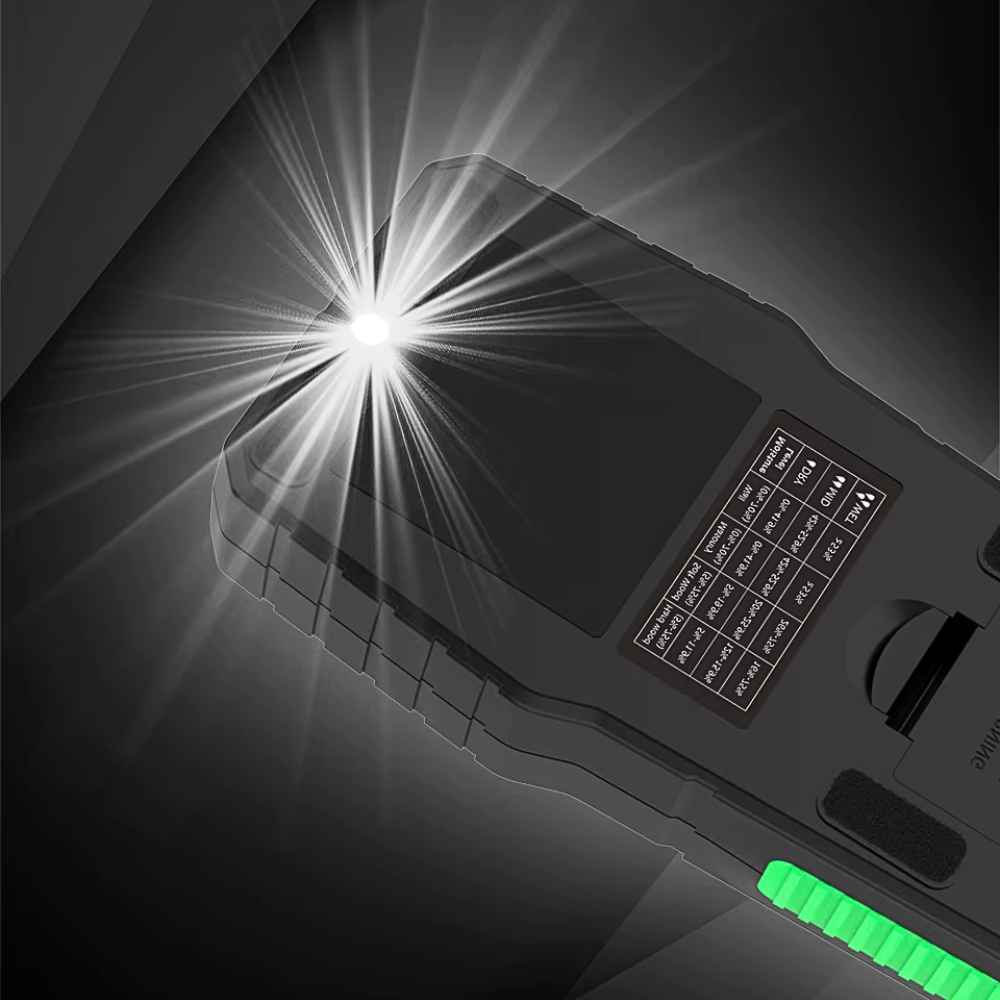
- The 2.7-inch LCD, one of the largest displays in this category, shows readings in 0.1% increments with a backlight, so you can scan boards inside a dim workshop or garage without squinting. The built-in flashlight is a genuinely useful bonus when you're digging through a dark lumber pile.
Specs That Actually Matter for Woodworkers:
The wood density selection lets you adjust for softwoods versus hardwoods, critical because a pine board and an oak board with the same true moisture content will read differently without this correction. The ±4% measurement error is appropriate for material-selection decisions, which is the primary use case here. The auto power-off at 5 minutes protects the single 9V battery (available with or without a rechargeable option), and battery level indication means you won't get a surprise dead reading mid-project.
Perfect for Hobby Woodworkers, Furniture Builders, and Firewood Buyers:
This meter fits three specific situations: a furniture maker who needs to confirm rough lumber is below 9% before dimensioning; a DIY deck builder scanning pressure-treated boards to decide if they need more drying time before staining; and a homeowner buying firewood who wants proof it's below 20% before loading the stove. In all three cases, you need speed, non-contact scanning, and a display you can actually read, not laboratory-grade precision.
Ready to stop guessing? Scan your next board before you cut it, and build with confidence from the first pass. And if you need another instrument, check our lumber moisture meter selection.
Share


FAQ - Moisture Meters
What is a moisture meter and what does it actually measure ?
A moisture meter is a handheld electronic instrument that quantifies the water content held within a solid material. Readings appear as % MC (moisture content) the ratio of water mass to the material's dry mass or as % WME (wood moisture equivalent), a normalized scale that converts non-wood readings to an equivalent wood reference for cross-material comparison.
SensoraHome meters cover ranges from 0–53% MC on wood and 0–99% on other building materials depending on the model and mode selected.
Pro tip
Always confirm your meter is in the correct calibration mode for the material you're testing. A wood-mode reading on drywall will not produce accurate absolute numbers.
What is the difference between a pin-type and a pinless moisture meter?
Pin-type meters drive two electrode pins into the surface to complete a low-voltage circuit. The meter calculates % MC from electrical resistance at the exact depth of insertion typically ¼" to 1". They leave two small marks and are the right tool when depth precision matters: thick lumber, dense hardwoods, or confirming that surface drying has reached the core.
Pinless meters project an electromagnetic field into the material without any surface contact. The meter detects moisture by how much the field return signal deviates from a dry-material baseline, averaging moisture across a scan footprint of several square inches to a depth of ¾"–1.5". They cover large surfaces fast with zero marks ideal for finished floors, tile, drywall, and wall surveys.
Most professional workflows combine both: pinless to scan and flag anomalies, pin to confirm depth and severity.
What does % WME mean on my moisture meter display?
% WME (Wood Moisture Equivalent) is a normalized reference scale that converts non-wood material readings into an equivalent wood moisture number useful when you need to compare readings across different materials on a single consistent display.
It does not mean the material is wood or that the reading reflects wood moisture specifically. It is a relative comparison tool, not an absolute measurement mode. For accurate absolute readings on drywall, concrete, or masonry, your meter must be set to the correct calibration mode for that specific material.