


Pinless Moisture Meter for Drywall
Pinless Moisture Meter for Drywall
☑️ Professional-Grade Accuracy
☑️ Instant Reliable Results
☑️ Catch Hidden Moisture, Save Thousands
☑️ 30-Day Returns
Couldn't load pickup availability
You've just patched a water-damaged wall. The surface looks dry. But what's hiding behind the paper face, in the gypsum core, in the second layer, behind the vapor barrier? That's exactly the question that costs contractors callbacks: trusting surface reads when the real problem is 30mm in.
The high-accuracy Moisture Meter Drywall addresses that gap directly. Its electromagnetic sensor penetrates up to 40mm below the surface, pulling moisture data from inside the drywall assembly, not just the paint layer everyone can already see.
What makes this unit specific to drywall diagnostics:
The surface can read dry while the gypsum core is already 30mm into a callback.
- Adjustable 5–40mm scan depth — a quick surface pass on a single panel, or full penetration to the gypsum-stud interface, your call.
- ±2.5% accuracy, 0–100% RH — catches borderline dampness and active saturation on both 1/2" and 5/8" panels.
- Pinless, zero needle holes — safe on freshly primed walls, occupied units, and pre-sale inspections.
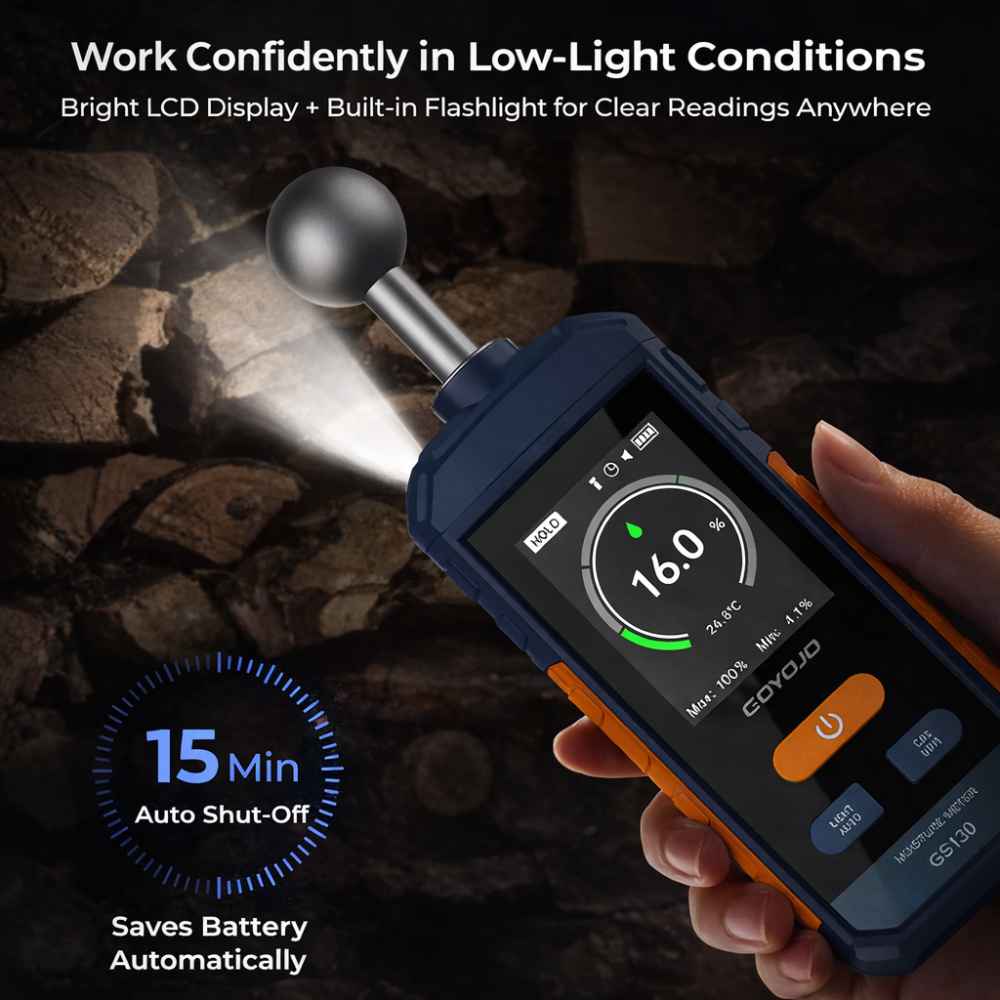
- Backlit display + built-in torch — read clearly in unlit crawl spaces and dark interior walls, no second hand needed.
- USB-C rechargeable, 1000mAh — no AA scramble mid-inspection, one charge covers multiple job days.
- 15-minute auto power-off — saves battery during walkthroughs where the meter sits idle between rooms.
Not Every Drywall Job Calls for the Same Scan Depth:
Replacing a single damaged panel in a kitchen? A 5mm surface pass confirms the surrounding drywall is dry before you tape and mud. Investigating a slow leak behind a tiled shower wall that's been seeping for six weeks?
Push the High-accuracy Moisture Meter Drywall to its full 40mm penetration and you're reading conditions at the gypsum-stud interface, the zone where mold colonies establish before any visual sign appears. That range flexibility is what separates a diagnostic tool from a go/no-go gadget. Restoration techs working IICRC S500 documentation know that a single fixed-depth reading doesn't satisfy a moisture map, you need layered data, and this moisture meter drywall adjustable 5–40mm window lets you build it room by room, surface by surface, without swapping instruments.
The Reading Pinless Moisture Meter for Drywall, That Stops Mold Before It Starts:
I ran one of these through a post-leak inspection on a basement bathroom. The surface read dry. At 35mm depth, the High-accuracy Moisture Meter Drywall flagged 68% RH behind the tile backer, exactly the kind of reading that would have been missed with a surface-only pin meter, and exactly the kind that prevents mold callbacks two months later.
This moisture detector fits the workflow of water damage restoration technicians and pre-close home inspectors who need non-invasive documentation across multiple rooms without stopping to swap batteries or find a flashlight.
Scan deeper. Document accurately. Move on to the next wall.
Share


FAQ - Moisture Meters
What is a moisture meter and what does it actually measure ?
A moisture meter is a handheld electronic instrument that quantifies the water content held within a solid material. Readings appear as % MC (moisture content) the ratio of water mass to the material's dry mass or as % WME (wood moisture equivalent), a normalized scale that converts non-wood readings to an equivalent wood reference for cross-material comparison.
SensoraHome meters cover ranges from 0–53% MC on wood and 0–99% on other building materials depending on the model and mode selected.
Pro tip
Always confirm your meter is in the correct calibration mode for the material you're testing. A wood-mode reading on drywall will not produce accurate absolute numbers.
What is the difference between a pin-type and a pinless moisture meter?
Pin-type meters drive two electrode pins into the surface to complete a low-voltage circuit. The meter calculates % MC from electrical resistance at the exact depth of insertion typically ¼" to 1". They leave two small marks and are the right tool when depth precision matters: thick lumber, dense hardwoods, or confirming that surface drying has reached the core.
Pinless meters project an electromagnetic field into the material without any surface contact. The meter detects moisture by how much the field return signal deviates from a dry-material baseline, averaging moisture across a scan footprint of several square inches to a depth of ¾"–1.5". They cover large surfaces fast with zero marks ideal for finished floors, tile, drywall, and wall surveys.
Most professional workflows combine both: pinless to scan and flag anomalies, pin to confirm depth and severity.
What does % WME mean on my moisture meter display?
% WME (Wood Moisture Equivalent) is a normalized reference scale that converts non-wood material readings into an equivalent wood moisture number useful when you need to compare readings across different materials on a single consistent display.
It does not mean the material is wood or that the reading reflects wood moisture specifically. It is a relative comparison tool, not an absolute measurement mode. For accurate absolute readings on drywall, concrete, or masonry, your meter must be set to the correct calibration mode for that specific material.