


Oak moisture meter | Studio
Oak moisture meter | Studio
☑️ Professional-Grade Accuracy
☑️ Instant Reliable Results
☑️ Catch Hidden Moisture, Save Thousands
☑️ 30-Day Returns
Couldn't load pickup availability
Oak Moisture Meter That Reads Hardwood Density, Not Just Surface Humidity:
Oak doesn't forgive late decisions. By the time a freshly installed white oak floor starts crowning or a mortise-and-tenon joint opens up, the moisture problem is already three weeks old , locked inside wood that looked perfectly fine on delivery day. The only way to catch it earlier is a meter with a measurement mode that respects how slowly and unevenly oak releases water.
| Mode | Measuring Range | Compatible Wood Species |
|---|---|---|
| M1 | 2% – 40% | Rhodesian teak, white red bean tree, Brazil walnut tree, etc. |
| M2 | 2% – 50% | Walnut, aspen, teak, fir, etc. |
| M3 | 2% – 60% | Douglas fir, Liu'an, Fraxinus mandshurica, white fir, etc. |
| M4 | 2% – 70% | Masson pine, Chile pine, larch, birch, etc. |
Oak Lives in M2 Territory and That Changes Everything:
Most softwood-focused meters top out at ranges that compress oak's critical drying window into an unreadable cluster of numbers. M2 mode on this meter opens that window wide:
- M2 (2%–50%): calibrated for walnut, aspen, teak and fir, the same density family as most domestic and European oak varieties
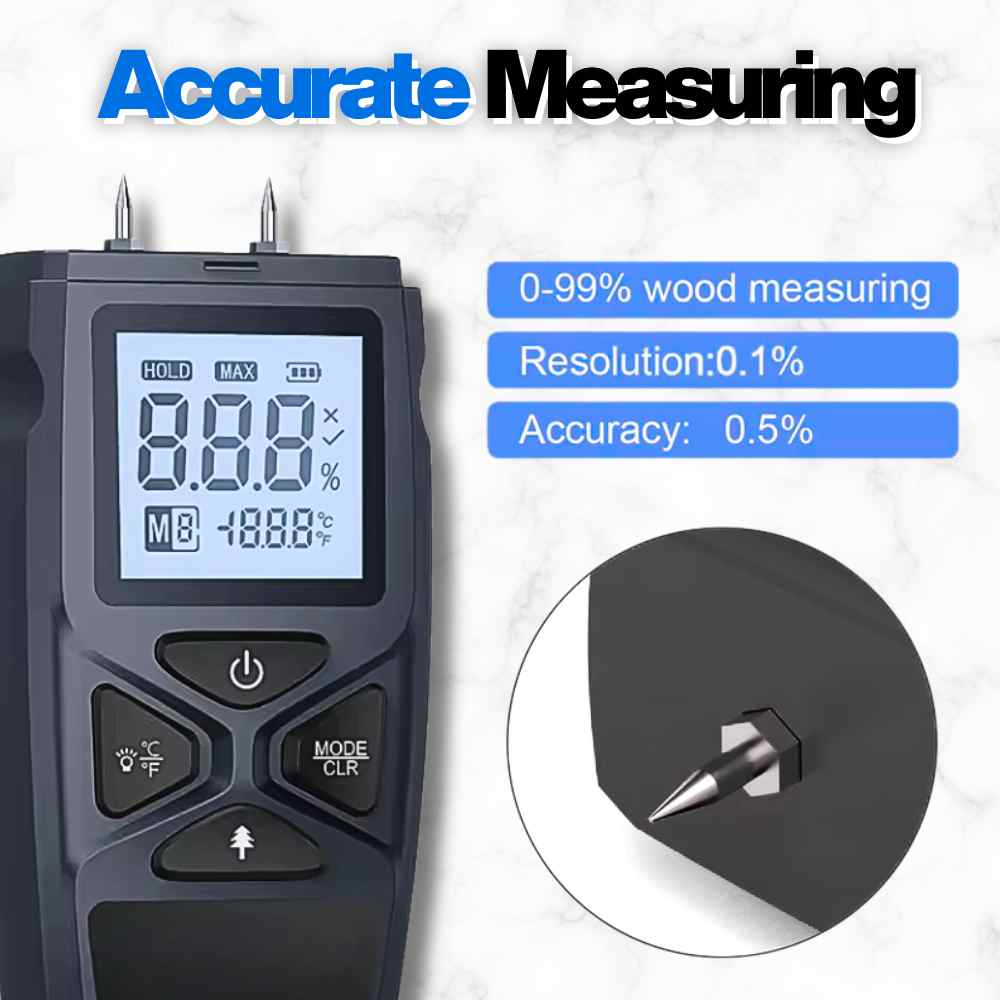
- 0.1% resolution: distinguishes 8.1% from 9.0% , the kind of gap that separates acceptable furniture-grade stock from wood that needs another three weeks in the stack
- Auto temperature compensation: stabilizes readings when you're moving oak boards from a cold storage shed into a heated workshop
- Data hold: locks the number while you mark the board , no re-probing a freshly moved plank
Spent a Saturday last fall working through a stack of air-dried red oak destined for a dining table build. Surface felt ready. M2 mode flagged four boards clustered in the center of the pile at 22–24% , way above the 8% target for indoor furniture. Those boards went back outside. The table went together without a single movement crack six months later.
Who Gets the Most Out of the Oak moisture meter?
- Custom furniture makers sourcing air-dried oak slabs from local mills where moisture content is never certified
- Hardwood flooring installers laying white oak planks over radiant heat systems where post-install shrinkage is unforgiving
- Woodworking hobbyists building with reclaimed oak barn wood that has unpredictable internal moisture pockets
Oak moisture meter, One Measurement That Earns Its Place on Your Bench:
No complicated setup. Select M2, press the pins into the face grain, read the number. The LCD displays units and symbols clearly , no squinting under workshop lighting. Auto power-off after 10 minutes means it's ready in your apron pocket without killing a 9V battery every week. And if you need, try more moisture meters for wood or moisture meters for lumber
Oak projects take months to plan and build. A four-second moisture check before the wood ever hits your bench is the cheapest insurance in your shop.
Share


FAQ - Moisture Meters
What is a moisture meter and what does it actually measure ?
A moisture meter is a handheld electronic instrument that quantifies the water content held within a solid material. Readings appear as % MC (moisture content) the ratio of water mass to the material's dry mass or as % WME (wood moisture equivalent), a normalized scale that converts non-wood readings to an equivalent wood reference for cross-material comparison.
SensoraHome meters cover ranges from 0–53% MC on wood and 0–99% on other building materials depending on the model and mode selected.
Pro tip
Always confirm your meter is in the correct calibration mode for the material you're testing. A wood-mode reading on drywall will not produce accurate absolute numbers.
What is the difference between a pin-type and a pinless moisture meter?
Pin-type meters drive two electrode pins into the surface to complete a low-voltage circuit. The meter calculates % MC from electrical resistance at the exact depth of insertion typically ¼" to 1". They leave two small marks and are the right tool when depth precision matters: thick lumber, dense hardwoods, or confirming that surface drying has reached the core.
Pinless meters project an electromagnetic field into the material without any surface contact. The meter detects moisture by how much the field return signal deviates from a dry-material baseline, averaging moisture across a scan footprint of several square inches to a depth of ¾"–1.5". They cover large surfaces fast with zero marks ideal for finished floors, tile, drywall, and wall surveys.
Most professional workflows combine both: pinless to scan and flag anomalies, pin to confirm depth and severity.
What does % WME mean on my moisture meter display?
% WME (Wood Moisture Equivalent) is a normalized reference scale that converts non-wood material readings into an equivalent wood moisture number useful when you need to compare readings across different materials on a single consistent display.
It does not mean the material is wood or that the reading reflects wood moisture specifically. It is a relative comparison tool, not an absolute measurement mode. For accurate absolute readings on drywall, concrete, or masonry, your meter must be set to the correct calibration mode for that specific material.