


Moisture meter for wood turning | Pro
Moisture meter for wood turning | Pro
☑️ Professional-Grade Accuracy
☑️ Instant Reliable Results
☑️ Catch Hidden Moisture, Save Thousands
☑️ 30-Day Returns
Couldn't load pickup availability
The Moisture Meter for Wood Turning That Tells You When a Blank Is Actually Ready:
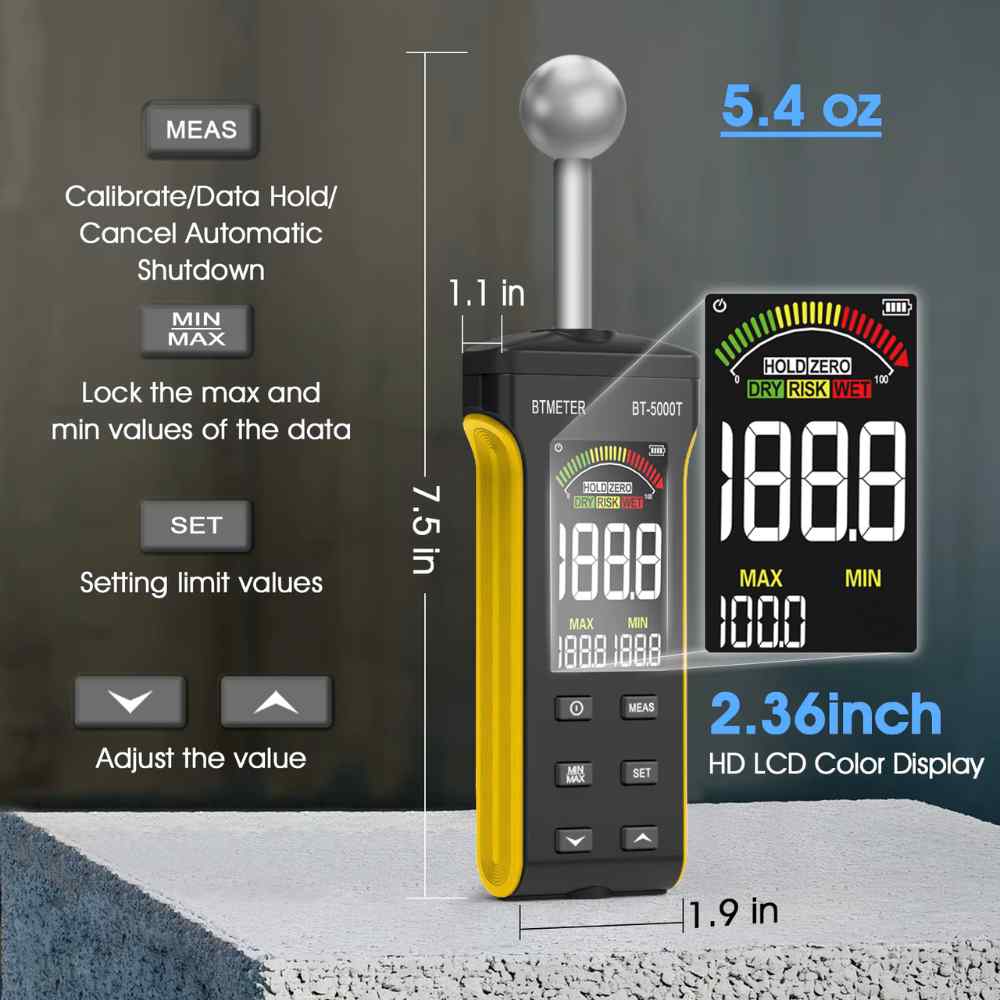
Every wood turner has done it: mounted a blank that seemed seasoned enough, started shaping, and watched a hairline crack open up mid-bowl or a finished vessel distort off-round two weeks after leaving the lathe. The blank wasn't ready. It looked dry on the outside, but the core was still holding moisture and moving. A wood moisture meter built for wood turning reads what your eye and your hand cannot , what's happening 20–40mm inside the blank, where movement actually originates.
| Moisture level | Wood | Concrete | Gypsum |
|---|---|---|---|
|
DRY
|
<50% | <25% | <30% |
|
RISK
|
50–80% | 25–50% | 30–60% |
|
WET
|
>80% | >50% | >60% |
Why Turning Blanks Need a Different Moisture Check?
A pin meter works on flat, dressed lumber. On a rough turning blank , bark-on, end-grain exposed, irregular surface , pins give inconsistent contact and only sample the outermost fibers. That's exactly where blanks dry fastest and mislead most. The spherical inductive sensor on this meter reads through the surface into the blank's core without touching it with a probe, leaving the wood completely unmarked for mounting.
- Non-flat surface compatible , the spherical sensor reads curved and irregular blank faces that defeat flat-plate pinless meters
- Maximum / minimum sweep function maps moisture gradient from end grain to face grain across the blank in one pass, revealing uneven drying before it becomes uneven movement on the lathe
- DRY / RISK / WET instant threshold display gives you a clear go/no-go on a blank without consulting a species moisture chart mid-session
- Non-destructive, zero-mark reading preserves the surface of figured, burled, or bark-edge blanks where a pin hole means a flaw in the finished piece
Moisture meter for wood turning In the Shop:
I had a walnut crotch blank air-drying for fourteen months , well past the one-year rule of thumb. Swept it with this meter before roughing it out. Face grain read DRY. End grain flagged RISK at depth near the crotch junction. Gave it another eight weeks. Turned clean, no movement after finishing. That reading saved a spectacular piece of wood from becoming a cracked bowl blank in the bin.
Wood turners working through green wood, twice-turned bowls, or kiln-dried exotics all face the same question before every session: is this blank stable enough? This meter answers it without leaving a mark. Also, you can discover more specifics wood tools on your website, as lumber moisture meters.
Your blanks represent hours of hunting, hauling, and waiting. A moisture meter that reads the core , not just the shell , is the only tool that tells you when that wait is actually over. Check before you mount.
Share


FAQ - Moisture Meters
What is a moisture meter and what does it actually measure ?
A moisture meter is a handheld electronic instrument that quantifies the water content held within a solid material. Readings appear as % MC (moisture content) the ratio of water mass to the material's dry mass or as % WME (wood moisture equivalent), a normalized scale that converts non-wood readings to an equivalent wood reference for cross-material comparison.
SensoraHome meters cover ranges from 0–53% MC on wood and 0–99% on other building materials depending on the model and mode selected.
Pro tip
Always confirm your meter is in the correct calibration mode for the material you're testing. A wood-mode reading on drywall will not produce accurate absolute numbers.
What is the difference between a pin-type and a pinless moisture meter?
Pin-type meters drive two electrode pins into the surface to complete a low-voltage circuit. The meter calculates % MC from electrical resistance at the exact depth of insertion typically ¼" to 1". They leave two small marks and are the right tool when depth precision matters: thick lumber, dense hardwoods, or confirming that surface drying has reached the core.
Pinless meters project an electromagnetic field into the material without any surface contact. The meter detects moisture by how much the field return signal deviates from a dry-material baseline, averaging moisture across a scan footprint of several square inches to a depth of ¾"–1.5". They cover large surfaces fast with zero marks ideal for finished floors, tile, drywall, and wall surveys.
Most professional workflows combine both: pinless to scan and flag anomalies, pin to confirm depth and severity.
What does % WME mean on my moisture meter display?
% WME (Wood Moisture Equivalent) is a normalized reference scale that converts non-wood material readings into an equivalent wood moisture number useful when you need to compare readings across different materials on a single consistent display.
It does not mean the material is wood or that the reading reflects wood moisture specifically. It is a relative comparison tool, not an absolute measurement mode. For accurate absolute readings on drywall, concrete, or masonry, your meter must be set to the correct calibration mode for that specific material.