


Moisture meter for water damage | FloodRead
Moisture meter for water damage | FloodRead
☑️ Professional-Grade Accuracy
☑️ Instant Reliable Results
☑️ Catch Hidden Moisture, Save Thousands
☑️ 30-Day Returns
Couldn't load pickup availability
Moisture Meter for Water Damage, Map Every Wet Zone Before You Miss One:
After a burst pipe flooded the laundry room wall in a client's house last March, I scanned the entire area with the FloodRead. What looked like a contained wet patch on the surface turned out to extend 18 inches further along the baseboard, hidden moisture the eye never catches. That's exactly the scenario this tool was built for.
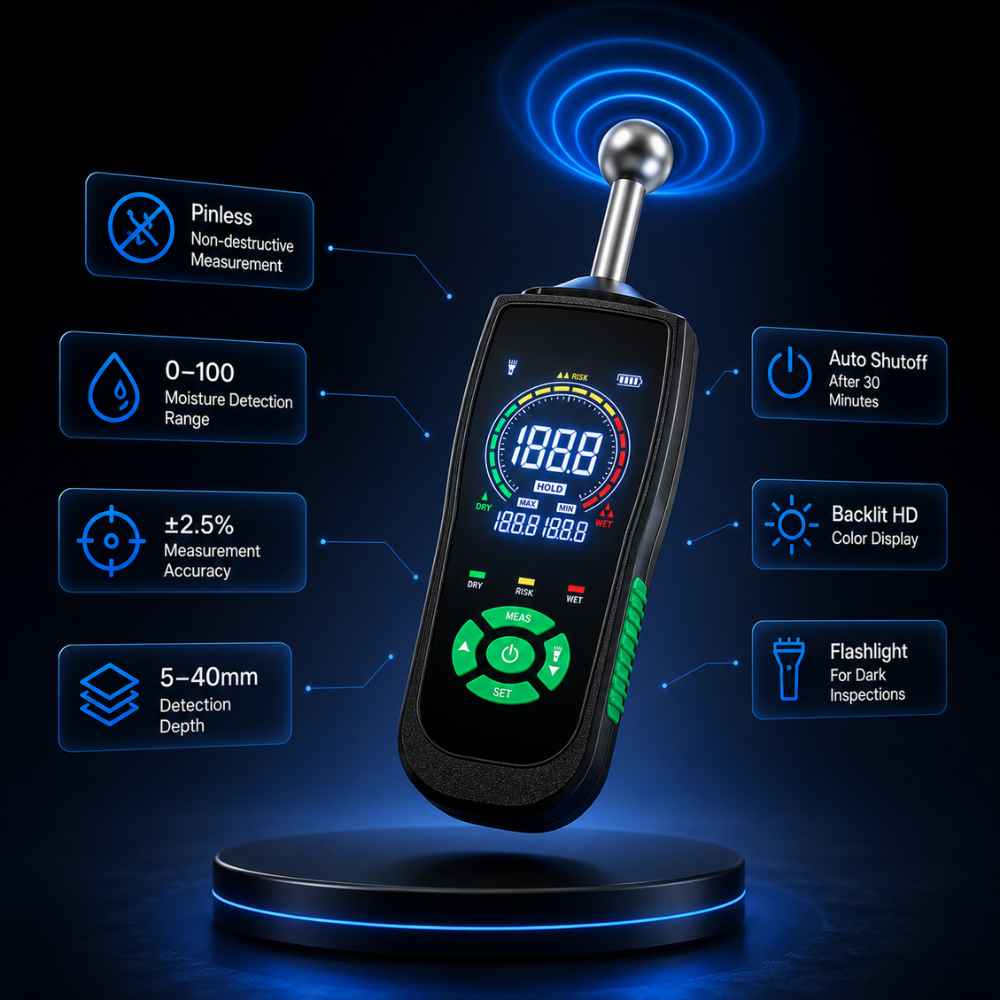
When you're dealing with water damage, the question isn't "is it wet?", you already know that. The real question is "how far did it spread, and through what?" A pinless moisture meter that reads up to 40mm (1.57 inch) below the surface, across plaster, cement-based walls, and wood subfloors without puncturing a single finished surface, is what separates a targeted repair from a full gut job.
| Material | LCD Display (digits) | Moisture Level |
|---|---|---|
| Plaster and anhydrite | < 30 | DRY |
| 30 ~ 60 | RISK | |
| > 60 | WET | |
| Cement-based materials | < 25 | DRY |
| 25 ~ 50 | RISK | |
| > 50 | WET | |
| Wood | < 50 | DRY |
| 50 ~ 80 | RISK | |
| > 80 | WET |
What Makes the FloodRead Different for Water Damage Assessment:
Water damage rarely respects material boundaries. One leak can saturate drywall, travel down into concrete screed, and wick sideways into wood flooring, all three in the same room. The FloodRead handles each with a single scan thanks to its calibrated multi-material reading scale:
- 0–100 measurement range across three distinct material types, so you're not misreading cement moisture thresholds as wood thresholds
- 40mm subsurface depth, catches moisture migrating behind plaster finishes and under tile adhesive beds before mold gets a foothold
- Built-in flashlight, essential when you're scanning ceilings, inside cabinets, or under kitchen units with standing water damage and no ambient light
- Customizable humidity alarm, set your wet threshold to match your specific job: remediation contractors restoring hurricane-damaged homes work to different tolerances than a homeowner drying out a basement after a slow leak
- MIN/MAX memory, logs the driest and wettest readings automatically so you can map spread across a room without writing anything down
3 Real Situations to use FloodRead Moisture meter for water damage:
Post-flood drywall assessment: Restoration contractors scanning walls after a slab leak use the FloodRead to identify which panels are above the WET threshold (>60 for plaster/anhydrite) before deciding what to demo, avoiding unnecessary removal and reducing client costs like a specific drywall moisture meter.
Subfloor moisture mapping after appliance leaks: A dishwasher leak that went unnoticed for two weeks will saturate both cement screed and the wood subfloor beneath. Scanning both layers in one pass without switching tools saves 20–30 minutes per room on a multi-room job.
Insurance documentation: The hold function and visible MIN/MAX values give you hard numbers to photograph and attach to a claim, "WET at 72 on plaster panel C4" is the kind of evidence that accelerates approvals.
The FloodRead gives you a complete moisture map of water-damaged surfaces in a single walkthrough, no pins, no holes, no surfaces that look worse after the inspection than before. If you're starting a water damage assessment, start here.
Share


FAQ - Moisture Meters
What is a moisture meter and what does it actually measure ?
A moisture meter is a handheld electronic instrument that quantifies the water content held within a solid material. Readings appear as % MC (moisture content) the ratio of water mass to the material's dry mass or as % WME (wood moisture equivalent), a normalized scale that converts non-wood readings to an equivalent wood reference for cross-material comparison.
SensoraHome meters cover ranges from 0–53% MC on wood and 0–99% on other building materials depending on the model and mode selected.
Pro tip
Always confirm your meter is in the correct calibration mode for the material you're testing. A wood-mode reading on drywall will not produce accurate absolute numbers.
What is the difference between a pin-type and a pinless moisture meter?
Pin-type meters drive two electrode pins into the surface to complete a low-voltage circuit. The meter calculates % MC from electrical resistance at the exact depth of insertion typically ¼" to 1". They leave two small marks and are the right tool when depth precision matters: thick lumber, dense hardwoods, or confirming that surface drying has reached the core.
Pinless meters project an electromagnetic field into the material without any surface contact. The meter detects moisture by how much the field return signal deviates from a dry-material baseline, averaging moisture across a scan footprint of several square inches to a depth of ¾"–1.5". They cover large surfaces fast with zero marks ideal for finished floors, tile, drywall, and wall surveys.
Most professional workflows combine both: pinless to scan and flag anomalies, pin to confirm depth and severity.
What does % WME mean on my moisture meter display?
% WME (Wood Moisture Equivalent) is a normalized reference scale that converts non-wood material readings into an equivalent wood moisture number useful when you need to compare readings across different materials on a single consistent display.
It does not mean the material is wood or that the reading reflects wood moisture specifically. It is a relative comparison tool, not an absolute measurement mode. For accurate absolute readings on drywall, concrete, or masonry, your meter must be set to the correct calibration mode for that specific material.