


Moisture meter for subfloor | FloorGuard
Moisture meter for subfloor | FloorGuard
☑️ Professional-Grade Accuracy
☑️ Instant Reliable Results
☑️ Catch Hidden Moisture, Save Thousands
☑️ 30-Day Returns
Couldn't load pickup availability
Moisture Meter for Subfloor, The Pre-Installation Scan That Prevents a $4,000 Callback:
I've seen it happen twice on the same street: flooring contractors who laid engineered hardwood over a subfloor that read fine at one test point, but had a wet pocket three feet over they never checked. Six months later, the floor was cupping. The callbacks, the ripping out, the client disputes. All avoidable with a proper pre-installation subfloor scan.
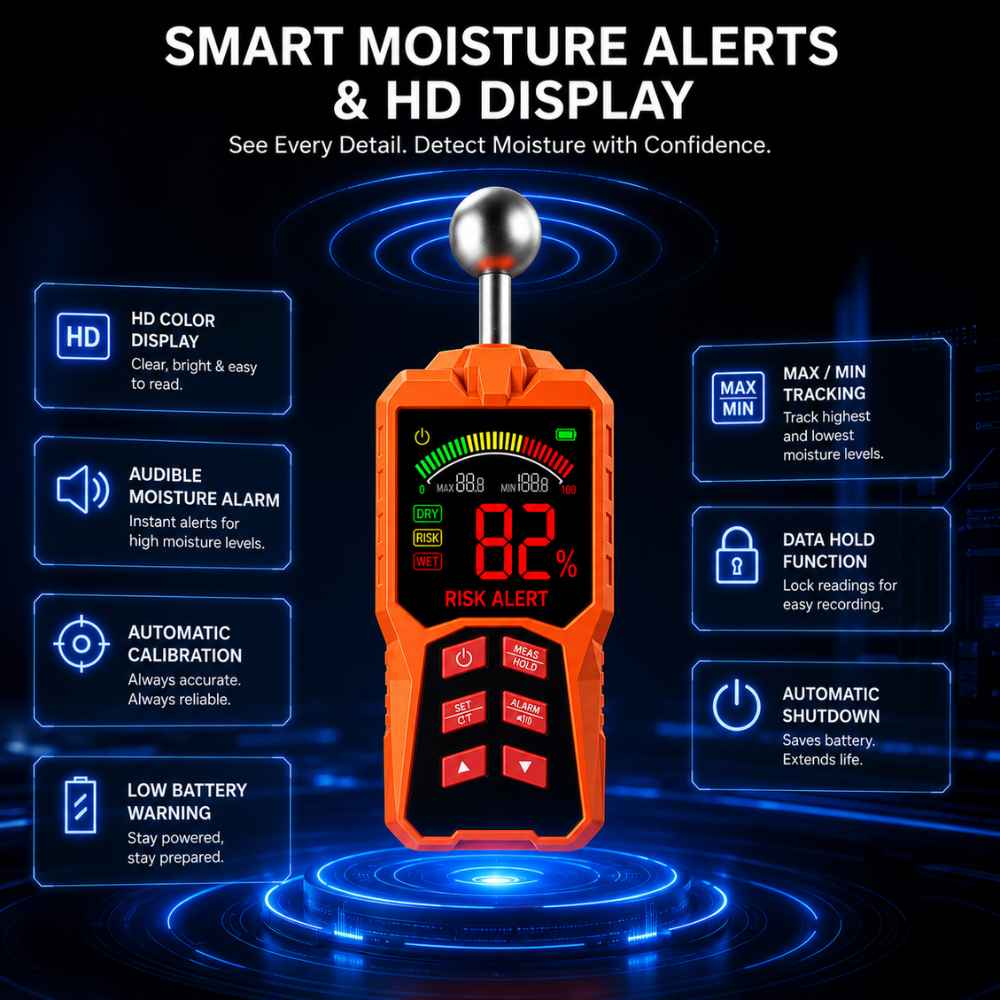
The difference with this moisture meter isn't just the reading, it's the spherical induction sensor that lets you glide continuously across an entire subfloor surface without stopping to insert pins, reset between spots, or leave a trail of holes in the substrate you're about to cover permanently.
| Materials | Numerical Value | Moisture Content Level |
|---|---|---|
| Gypsum (Minerals) | < 30 | DRY |
| 30 ~ 60 | RISK | |
| > 60 | WET | |
| Cement Base Material | < 25 | DRY |
| 25 ~ 50 | RISK | |
| > 50 | WET | |
| Wooden Paper | < 50 | DRY |
| 50 ~ 80 | RISK | |
| > 80 | WET |
Why the Spherical Sensor FloorGuard Changes Subfloor Inspection Completely:
Traditional pin meters test one 2-inch circle at a time. A 400 sq ft living room subfloor has thousands of those circles. Nobody tests all of them, which is exactly how wet pockets get buried under $8/sq ft hardwood.
This pinless moisture detector reads 5–40mm below the surface as you move, flagging wet zones in real time so you can circle them with chalk, let the GC know, and document the decision before a single board goes down.
What makes this scanner uniquely suited for subfloor work before installation:
- Spherical induction probe, maintains consistent surface contact on uneven OSB and plywood panels without repositioning pressure
- 5–40mm detection depth, reaches into the wood layers beneath the surface face, not just what's sitting on top
- Instant real-time readings, no stabilization wait, scan an entire room in a single continuous walkthrough rather than stopping at 30 marked grid points
- Automatic calibration function, eliminates the 3-minute manual recalibration that pin meters require when switching from one subfloor material to another mid-job
- Three-zone color alert (DRY / RISK / WET), tells flooring installers exactly which zones need 48 more hours of drying before the moisture content in wood subfloor panels is within installation tolerance
Three Subfloor Scenarios Where the FloorGuard sensor Pays for Itself:
New construction pre-install check: Framers leave plywood subfloors exposed for weeks before flooring crews arrive. A single wet pocket from a slow roof leak, undetected, will ruin a full hardwood installation. A 10-minute walkthrough with this meter before the first board gets laid is the cleanest insurance you can buy.
Post-concrete pour drying verification: Flooring contractors waiting on a concrete slab to hit the 3 lbs/1000 sq ft moisture threshold use this scanner to confirm which zones are still above the cement-base RISK threshold (25–50) before committing to adhesive application.
Flip project subfloor assessment: Investors rehabbing properties with unknown moisture history can scan the entire subfloor before pricing the job, distinguishing panels that need replacement from panels that are genuinely dry and structurally sound.
Install floor with confidence. Not with hope:
A subfloor lumber moisture meter that lets you cover an entire room in minutes, without a single pin hole, is the difference between a floor that performs for 20 years and one you're back to fix in six months. Scan it first.
Share


FAQ - Moisture Meters
What is a moisture meter and what does it actually measure ?
A moisture meter is a handheld electronic instrument that quantifies the water content held within a solid material. Readings appear as % MC (moisture content) the ratio of water mass to the material's dry mass or as % WME (wood moisture equivalent), a normalized scale that converts non-wood readings to an equivalent wood reference for cross-material comparison.
SensoraHome meters cover ranges from 0–53% MC on wood and 0–99% on other building materials depending on the model and mode selected.
Pro tip
Always confirm your meter is in the correct calibration mode for the material you're testing. A wood-mode reading on drywall will not produce accurate absolute numbers.
What is the difference between a pin-type and a pinless moisture meter?
Pin-type meters drive two electrode pins into the surface to complete a low-voltage circuit. The meter calculates % MC from electrical resistance at the exact depth of insertion typically ¼" to 1". They leave two small marks and are the right tool when depth precision matters: thick lumber, dense hardwoods, or confirming that surface drying has reached the core.
Pinless meters project an electromagnetic field into the material without any surface contact. The meter detects moisture by how much the field return signal deviates from a dry-material baseline, averaging moisture across a scan footprint of several square inches to a depth of ¾"–1.5". They cover large surfaces fast with zero marks ideal for finished floors, tile, drywall, and wall surveys.
Most professional workflows combine both: pinless to scan and flag anomalies, pin to confirm depth and severity.
What does % WME mean on my moisture meter display?
% WME (Wood Moisture Equivalent) is a normalized reference scale that converts non-wood material readings into an equivalent wood moisture number useful when you need to compare readings across different materials on a single consistent display.
It does not mean the material is wood or that the reading reflects wood moisture specifically. It is a relative comparison tool, not an absolute measurement mode. For accurate absolute readings on drywall, concrete, or masonry, your meter must be set to the correct calibration mode for that specific material.