


Moisture Meter for OSB | High-accuracy
Moisture Meter for OSB | High-accuracy
☑️ Professional-Grade Accuracy
☑️ Instant Reliable Results
☑️ Catch Hidden Moisture, Save Thousands
☑️ 30-Day Returns
Couldn't load pickup availability
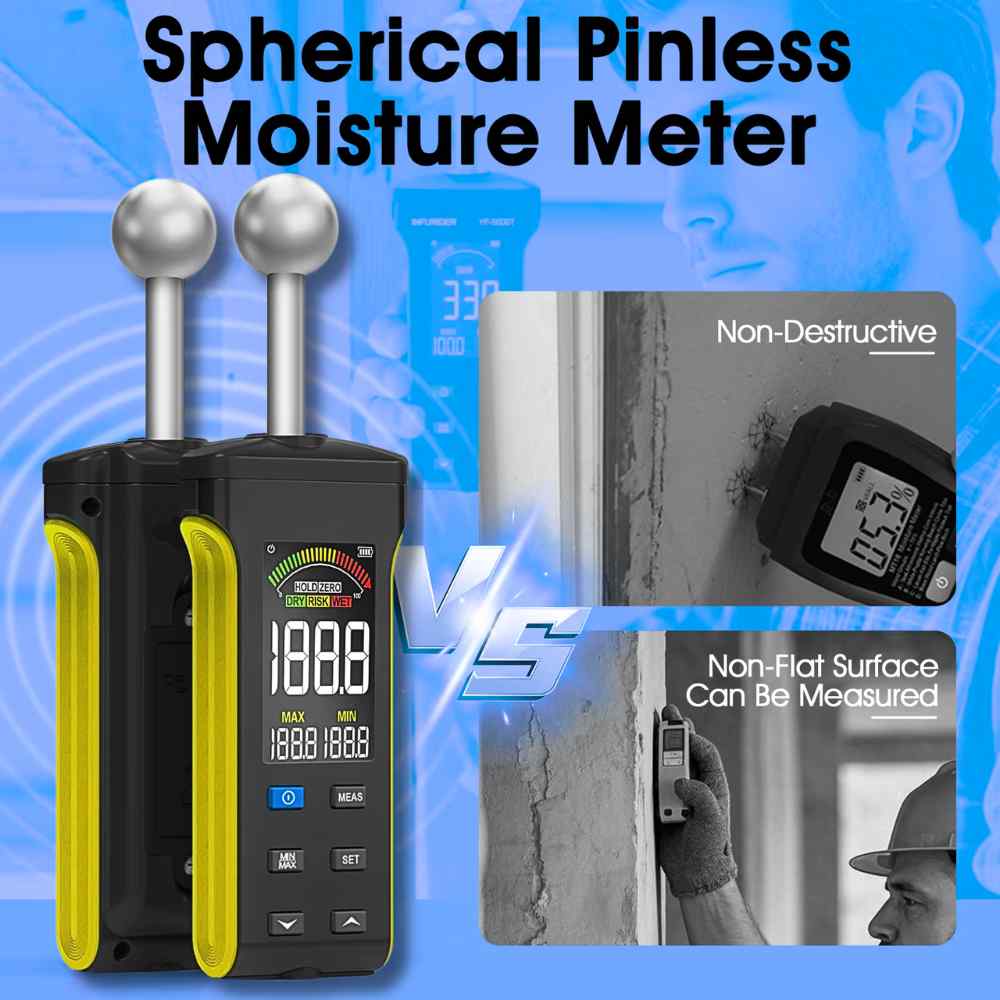
Moisture Meter for OSB That Reads Through the Panel, Without a Single Pin Hole:
OSB is unforgiving. Unlike solid wood, oriented strand board absorbs moisture at the edges and face faster than it releases it , and once it starts swelling, there's no going back. By the time the buckling shows on a roof deck or a subfloor, the sheathing is already compromised. A moisture meter built for OSB has to read what's happening inside the panel, not just on its surface. This pinless spherical detector does exactly that, reaching 20–40mm deep without puncturing a single strand.
| Moisture level | Wood | Concrete | Gypsum |
|---|---|---|---|
|
DRY
|
<50% | <25% | <30% |
|
RISK
|
50–80% | 25–50% | 30–60% |
|
WET
|
>80% | >50% | >60% |
Why OSB Demands a Different Kind of Check?
Pin wood moisture meters were designed for solid lumber. On OSB, driving pins into the compressed strand matrix gives inconsistent contact and surface-only readings that tell you nothing about moisture trapped in the panel core , where delamination actually starts. The spherical inductive technology in this meter bypasses that problem entirely.
- Non-destructive scan at 20–40mm depth catches moisture migrating through OSB core before face swelling or edge bloat becomes visible
- 0–100% range with DRY / RISK / WET thresholds translates raw readings into clear pass/fail calls , no OSB moisture table to cross-reference manually
- Max/min sweep function maps moisture variation across a full sheet in one pass, identifying wet zones near seams, fastener lines, or exposed edges
- Non-flat surface compatible , reads OSB panels laid at angles on roof decks or curved subfloor assemblies without losing accuracy
- Rubber-coated body with drop resistance survives the jobsite realities of framing and sheathing work
Where the Moisture Meter for OSB Gets Used:
Framers checking OSB wall sheathing after a rain delay before housewrap goes on. Roofing crews verifying deck panels before felt and underlayment installation. Custom home builders sweeping subfloor OSB before engineered hardwood or tile adhesive is applied , because a 4×8 sheet that reads RISK at mid-depth will telegraph movement through every finish layer above it.
I ran this meter across a batch of OSB subfloor panels stored uncovered on a job site over a wet weekend. Surface felt dry to the touch. Three sheets near the stack's edge flagged RISK at depth , enough to pull them and replace before the LVT went down. That call saved a tearout.
OSB doesn't give you a second chance once it's enclosed. A moisture meter calibrated to read through the panel , not just across it , is the only check that actually means something before you close in the wall or nail down the deck. Also, you can explore our different woodworking tools such as lumber moisture meter.
Share


FAQ - Moisture Meters
What is a moisture meter and what does it actually measure ?
A moisture meter is a handheld electronic instrument that quantifies the water content held within a solid material. Readings appear as % MC (moisture content) the ratio of water mass to the material's dry mass or as % WME (wood moisture equivalent), a normalized scale that converts non-wood readings to an equivalent wood reference for cross-material comparison.
SensoraHome meters cover ranges from 0–53% MC on wood and 0–99% on other building materials depending on the model and mode selected.
Pro tip
Always confirm your meter is in the correct calibration mode for the material you're testing. A wood-mode reading on drywall will not produce accurate absolute numbers.
What is the difference between a pin-type and a pinless moisture meter?
Pin-type meters drive two electrode pins into the surface to complete a low-voltage circuit. The meter calculates % MC from electrical resistance at the exact depth of insertion typically ¼" to 1". They leave two small marks and are the right tool when depth precision matters: thick lumber, dense hardwoods, or confirming that surface drying has reached the core.
Pinless meters project an electromagnetic field into the material without any surface contact. The meter detects moisture by how much the field return signal deviates from a dry-material baseline, averaging moisture across a scan footprint of several square inches to a depth of ¾"–1.5". They cover large surfaces fast with zero marks ideal for finished floors, tile, drywall, and wall surveys.
Most professional workflows combine both: pinless to scan and flag anomalies, pin to confirm depth and severity.
What does % WME mean on my moisture meter display?
% WME (Wood Moisture Equivalent) is a normalized reference scale that converts non-wood material readings into an equivalent wood moisture number useful when you need to compare readings across different materials on a single consistent display.
It does not mean the material is wood or that the reading reflects wood moisture specifically. It is a relative comparison tool, not an absolute measurement mode. For accurate absolute readings on drywall, concrete, or masonry, your meter must be set to the correct calibration mode for that specific material.