


Moisture meter for crawl space | CrawlGuard
Moisture meter for crawl space | CrawlGuard
☑️ Professional-Grade Accuracy
☑️ Instant Reliable Results
☑️ Catch Hidden Moisture, Save Thousands
☑️ 30-Day Returns
Couldn't load pickup availability
Why Crawl Space Wood Beams Show 8% on a Visual Check but 23% on a Probe?
The gap between what you can see and what's actually happening inside a floor joist is where structural damage starts. A crawl space dampness detector that only does surface scanning will miss subsurface saturation in dense hardwood, the kind that reads clean visually but is already feeding a mold colony three millimeters in.
A joist can look dry and still read 23% underneath. Know before it becomes a remediation invoice.
- Pin + pinless in one press — deep structural readings or non-invasive surface scans, no menu diving, no second tool.
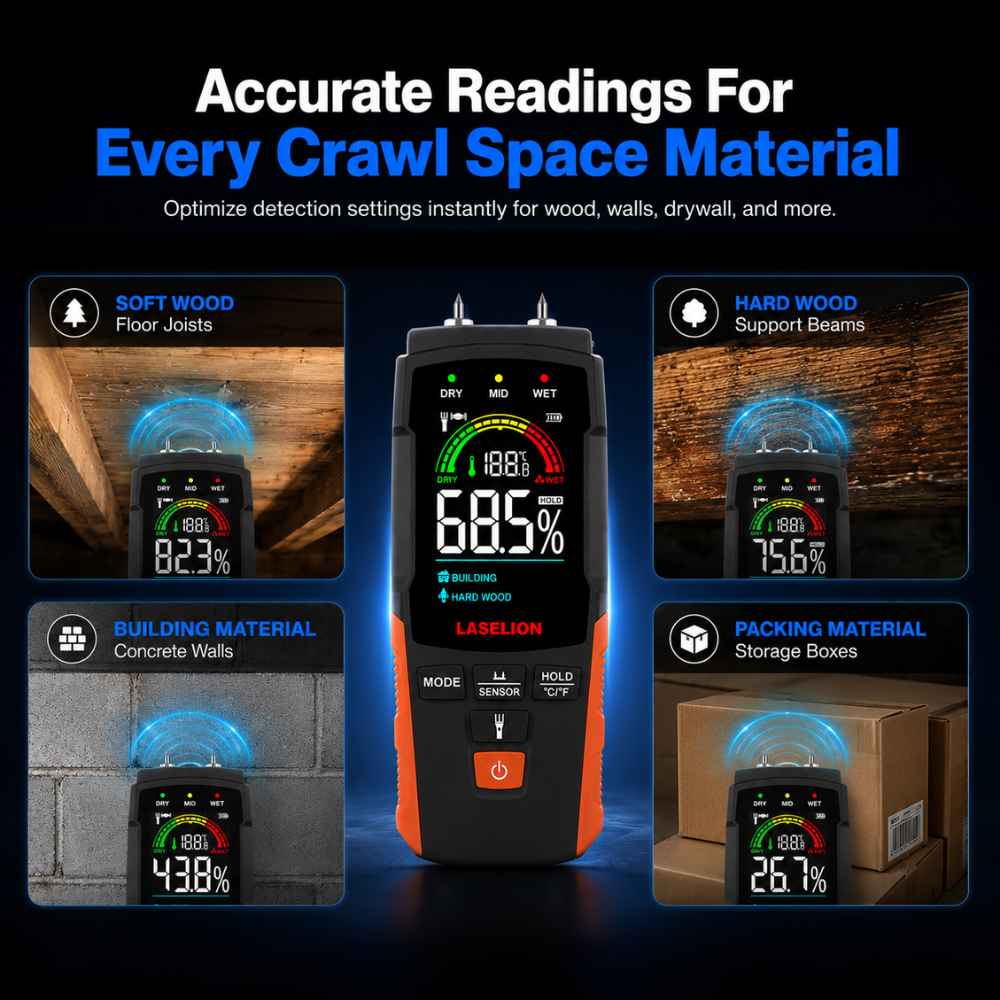
- 4 calibrated material profiles — softwood, hardwood, packing, and building material, each with its own accurate threshold.
- Audible alarm at WET threshold — an unambiguous signal, no number to interpret in a rushed inspection.
- Color gauge + 3 LED zones — green, yellow, red at a glance, readable across the whole crawl space in low light.
- HOLD function — freeze the reading to take notes or a photo without losing the value mid-inspection.
- 0% to 99.9% range, no calibration step — ready at first power-on, joists to subfloor panels to concrete stem walls.
The CrawlGuard operates across four distinct testing modes: pin mode for deep internal readings that penetrate surface layers, and pinless mode for fast non-invasive scanning across finished or fragile surfaces. The third time I pressed pins into a subfloor beam that a visual sweep had cleared, the display locked at 23.6%, well into the WET threshold for softwood, while the pinless scan of the adjacent surface had shown 19%.
That 4-point spread on the same joist told a different story than the one the homeowner had been living with for two years. The meter's color LCD shows the active reading in large digits alongside a semicircular gauge that moves from green (DRY) through yellow (MID) into red (WET), with three LED indicators across the top that match the zone. Switching between pin and pinless takes one button press. No menu diving, no recalibration between modes.
Judgment of moisture level
| Moisture level | Soft wood | Hard wood | Packing | Building |
|---|---|---|---|---|
| DRY | <20% | <12% | <13% | <8% |
| MID | 20~26% | 12~16% | 13~21% | 8~12% |
| WET | >26% | >16% | >21% | >12% |
Thresholds vary by material type. Switch material mode on the meter before reading.
What the CrawlGuard Measures Across Four Material Categories in a Single Inspection?
This wood moisture meter measures dampness across four calibrated material profiles: softwood (floor joists, dimensional lumber), hardwood (support beams, engineered timber), packing material (cardboard, crates), and building material (concrete walls, masonry).
Each profile applies a different conductivity model, which matters because a 15% reading on softwood signals a mid-range moisture condition while the same number on hardwood already exceeds the WET threshold. The meter displays both the current material profile and the moisture percentage simultaneously on its color screen, so there is no ambiguity about which scale is active.
The CrawlGuard 2-in-1 moisture meter detects water content across wood and building materials from 0% to 99.9% in pinless mode and within calibrated species ranges in pin mode, with a three-tier classification system (DRY, MID, WET) that triggers an audible alarm and LED alert at the WET threshold, giving a crawl space inspector an immediate, unambiguous signal without needing to read the number.
Two Detection Approaches for Every Surface a Crawl Space Puts in Front of You:
Pin mode drives two metal probes into the material surface to measure electrical resistance between them, a method that captures moisture at depth and gives the most precise reading on structural lumber.
Pinless mode uses electromagnetic scanning to detect moisture content without surface contact, which protects finished flooring, vapor barriers, and insulation that would be damaged by pin punctures.
Neither mode requires a separate calibration step between uses. For a home inspector running a crawl space assessment across joists, subfloor panels, concrete stem walls, and any cardboard storage left by the homeowner, switching modes mid-inspection rather than carrying two separate tools eliminates the logistical problem that leads to incomplete documentation.
The display holds the last reading when HOLD is activated, which allows note-taking or photographing the result without losing the value. Temperature is displayed in the upper section of the screen in both Celsius and Fahrenheit (switchable), providing ambient condition context alongside the moisture reading. Explore the full lineup of moisture meters at sensorahome.com/collections/moisture-meter or view all wood moisture meters at sensorahome.com/collections/wood-moisture-meter.
Stop Moisture at the Beam with this Moisture meter for crawl space, Not at the Remediation Invoice:
For anyone walking into a crawl space with aging joists and no baseline moisture data, the cost of a single missed wet reading compounds over months. Both modes are ready at first power-on, the display is readable in low light, and the alarm removes any ambiguity at the threshold that matters. Add it to your kit before the next inspection.
Share


FAQ - Moisture Meters
What is a moisture meter and what does it actually measure ?
A moisture meter is a handheld electronic instrument that quantifies the water content held within a solid material. Readings appear as % MC (moisture content) the ratio of water mass to the material's dry mass or as % WME (wood moisture equivalent), a normalized scale that converts non-wood readings to an equivalent wood reference for cross-material comparison.
SensoraHome meters cover ranges from 0–53% MC on wood and 0–99% on other building materials depending on the model and mode selected.
Pro tip
Always confirm your meter is in the correct calibration mode for the material you're testing. A wood-mode reading on drywall will not produce accurate absolute numbers.
What is the difference between a pin-type and a pinless moisture meter?
Pin-type meters drive two electrode pins into the surface to complete a low-voltage circuit. The meter calculates % MC from electrical resistance at the exact depth of insertion typically ¼" to 1". They leave two small marks and are the right tool when depth precision matters: thick lumber, dense hardwoods, or confirming that surface drying has reached the core.
Pinless meters project an electromagnetic field into the material without any surface contact. The meter detects moisture by how much the field return signal deviates from a dry-material baseline, averaging moisture across a scan footprint of several square inches to a depth of ¾"–1.5". They cover large surfaces fast with zero marks ideal for finished floors, tile, drywall, and wall surveys.
Most professional workflows combine both: pinless to scan and flag anomalies, pin to confirm depth and severity.
What does % WME mean on my moisture meter display?
% WME (Wood Moisture Equivalent) is a normalized reference scale that converts non-wood material readings into an equivalent wood moisture number useful when you need to compare readings across different materials on a single consistent display.
It does not mean the material is wood or that the reading reflects wood moisture specifically. It is a relative comparison tool, not an absolute measurement mode. For accurate absolute readings on drywall, concrete, or masonry, your meter must be set to the correct calibration mode for that specific material.