


I like it
1
/
of
3
Moisture meter cedar | Field
Moisture meter cedar | Field
Regular price
$79 USD
Regular price
Sale price
$79 USD
☑️ Professional-Grade Accuracy
☑️ Instant Reliable Results
☑️ Catch Hidden Moisture, Save Thousands
☑️ 30-Day Returns
Free Shipping
On orders over $100
Estimated delivery
Calculating…
Couldn't load pickup availability
Pay
Pay
30-Day Returns
Exchange or refund
Order Tracking
Automatic tracking updates
Secure Payment
Card, Shop Pay, Apple Pay
Customer Service
Response within 24-48h
Moisture Meter for Cedar That Accounts for How Teak and White Cedar Actually Dry:
Cedar is deceptive. Pull a board off a stack and it feels dry , light, almost papery. Then you install it, and six weeks later the siding is cupping or the fence rails are splitting at the joints. The problem isn't your technique. It's that you trusted your hands instead of a meter calibrated to cedar's specific moisture curve.
| Mode | Measuring Range | Compatible Wood Species |
|---|---|---|
| M1 | 2% – 40% | Rhodesian teak, white red bean tree, Brazil walnut tree, etc. |
| M2 | 2% – 50% | Walnut, aspen, teak, fir, etc. |
| M3 | 2% – 60% | Douglas fir, Liu'an, Fraxinus mandshurica, white fir, etc. |
| M4 | 2% – 70% | Masson pine, Chile pine, larch, birch, etc. |
Why Generic Meters Lie to Cedar Workers?
White red bean tree and Rhodesian teak share M1's 2%–40% range with cedar , and that's not an accident. These are dense, slow-drying species where the difference between 12% and 18% moisture content is invisible to the touch but catastrophic to a finished installation. M1 mode on this meter was built precisely for that window and if you need more mode, try our complete collection of wood moisture detectors
Specs That Cedar Contractors Actually Use:
- M1 mode (2%–40%): the exact range where cedar installation decisions live
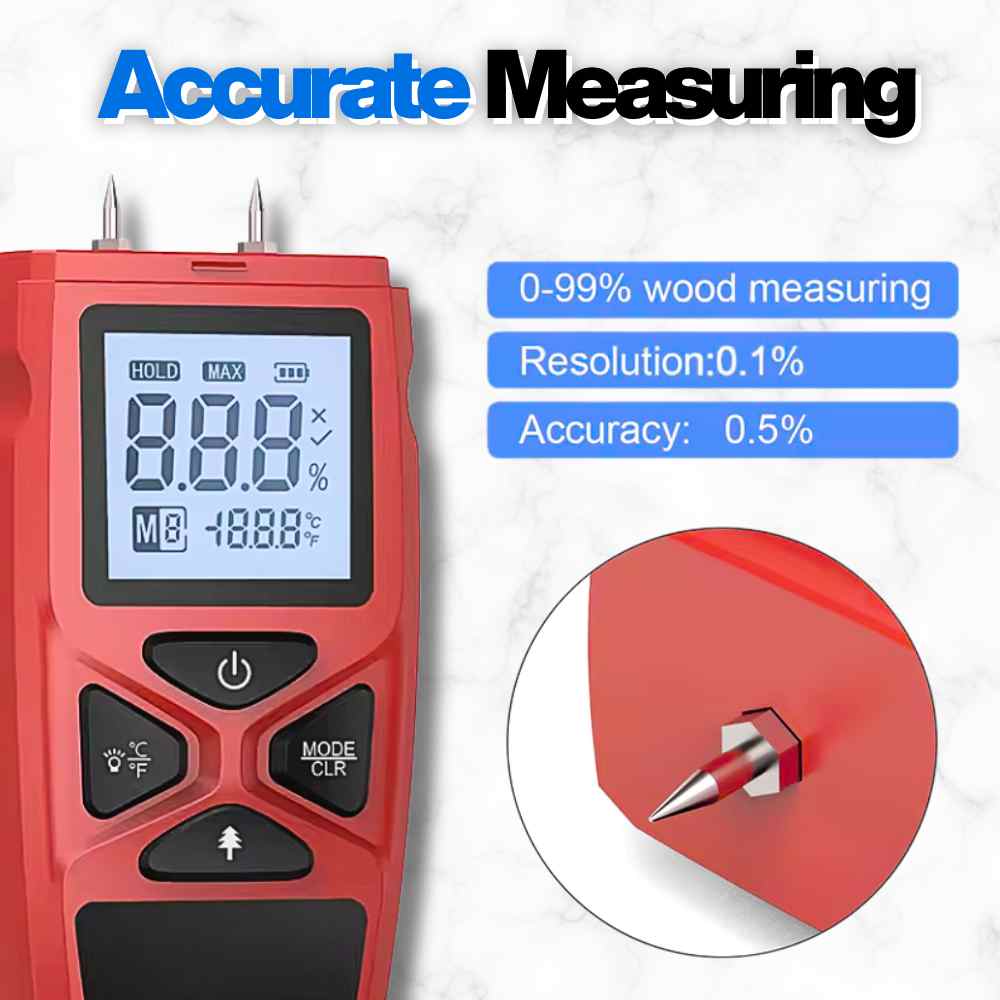
- 0.1% resolution: catches the 1–2% moisture variance between boards in the same bundle
- Auto temperature compensation: critical when moving cedar from a shaded storage yard into a sun-exposed job site
- Data hold function: reads through your gloves in winter without re-probing
- Large LCD with units and symbols: readable at arm's length on a ladder
I remember checking a shipment of western red cedar for a deck project on a foggy San Jose morning. Every board felt bone dry. The meter told a different story , three boards in the middle of the bundle sitting at 19%, surrounded by boards at 11%. Without M1 mode, those three boards go straight into the deck frame.
The Moisture meter for cedar, Who This Is For?
- Cedar siding contractors verifying kiln-dried stock before nailing
- Fence builders working with rough-sawn cedar in variable humidity climates
- Custom home builders specifying cedar ceiling planks or closet liners who need documented moisture readings before sign-off
One reading per board takes four seconds. The M1 mode gives you a number specific to cedar's drying behavior , not pine's, not oak's. Install with confidence or pull the board. Either way, you're not guessing without a good lumber moisture meter
Share


Customer Reviews
Overall rating: 5.0 / 5 from 1 reviews.
FAQ - Moisture Meters
What is a moisture meter and what does it actually measure ?
A moisture meter is a handheld electronic instrument that quantifies the water content held within a solid material. Readings appear as % MC (moisture content) the ratio of water mass to the material's dry mass or as % WME (wood moisture equivalent), a normalized scale that converts non-wood readings to an equivalent wood reference for cross-material comparison.
SensoraHome meters cover ranges from 0–53% MC on wood and 0–99% on other building materials depending on the model and mode selected.
Pro tip
Always confirm your meter is in the correct calibration mode for the material you're testing. A wood-mode reading on drywall will not produce accurate absolute numbers.
What is the difference between a pin-type and a pinless moisture meter?
Pin-type meters drive two electrode pins into the surface to complete a low-voltage circuit. The meter calculates % MC from electrical resistance at the exact depth of insertion typically ¼" to 1". They leave two small marks and are the right tool when depth precision matters: thick lumber, dense hardwoods, or confirming that surface drying has reached the core.
Pinless meters project an electromagnetic field into the material without any surface contact. The meter detects moisture by how much the field return signal deviates from a dry-material baseline, averaging moisture across a scan footprint of several square inches to a depth of ¾"–1.5". They cover large surfaces fast with zero marks ideal for finished floors, tile, drywall, and wall surveys.
Most professional workflows combine both: pinless to scan and flag anomalies, pin to confirm depth and severity.
What does % WME mean on my moisture meter display?
% WME (Wood Moisture Equivalent) is a normalized reference scale that converts non-wood material readings into an equivalent wood moisture number useful when you need to compare readings across different materials on a single consistent display.
It does not mean the material is wood or that the reading reflects wood moisture specifically. It is a relative comparison tool, not an absolute measurement mode. For accurate absolute readings on drywall, concrete, or masonry, your meter must be set to the correct calibration mode for that specific material.