


Masonry moisture meter | DeepScan
Masonry moisture meter | DeepScan
☑️ Professional-Grade Accuracy
☑️ Instant Reliable Results
☑️ Catch Hidden Moisture, Save Thousands
☑️ 30-Day Returns
Couldn't load pickup availability
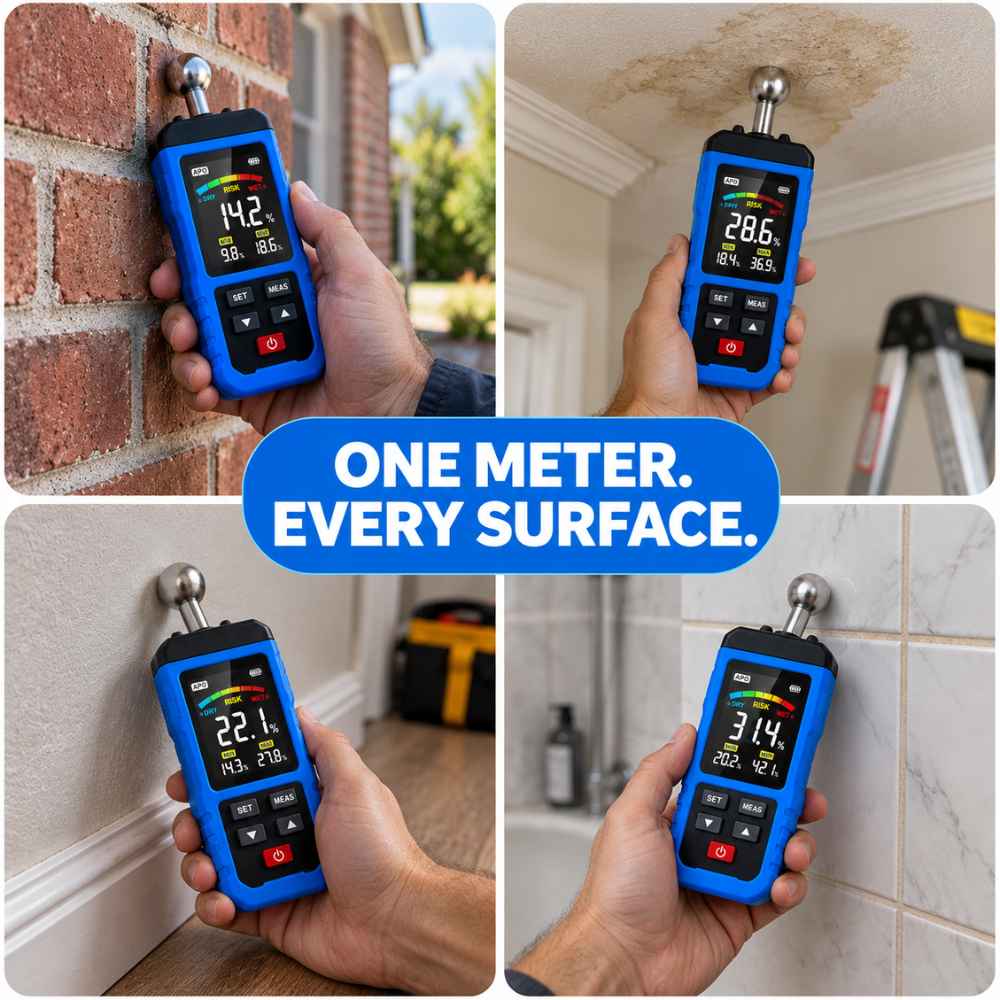
Pinless inductive detection across masonry, drywall, concrete, wood, and brick, with a full-angle spherical sensor engineered to reach tight corners and behind pipes.
What a Masonry Moisture Meter Actually Needs to Do Behind Tile and Plaster?
Most wall inspections fail before the meter even turns on. A pin-type tool leaves two puncture marks in every surface you test, costs time to reposition, and reads only the material it physically contacts.
When the moisture is sitting 20mm into a cement render or hiding at the base of a drywall stud, pin probes miss it entirely. The DeepScan uses inductive electromagnetic technology, the same scanning principle used in professional building surveys, to read subsurface moisture without breaking the surface.
The full-angle spherical sensor means the probe tip makes useful contact regardless of angle, which matters the moment you are working under a vanity cabinet or along a baseboard that sits flush to the floor.
Material Moisture Thresholds
Thresholds vary by material mode. An audible and visual alarm activates at customizable RISK and WET thresholds.
How This Pinless Masonry Detector Reads Cement, Gypsum, and Wood on a Single Scale
The meter carries three calibrated material modes: Wood, Cement/Concrete, and Gypsum/Mineral. Each mode applies a different conductivity baseline so the displayed reading reflects actual moisture content for that material type, not a generic relative scale. For wood, the instrument classifies readings below 50 as dry, 50 to 80 as risk-range, and above 80 as wet, with an audible and visual alarm triggering at customizable RISK and WET thresholds.
Cement thresholds shift to 25 and 50; gypsum to 30 and 60, which matters because a reading of 45 on a cement wall is a risk-level concern, while the same value on a gypsum board is already in the wet zone.
The color LCD displays the current moisture value in large digits a min/max session memory and a live arc gauge that moves from green through yellow to red.
I ran this meter across a bathroom wall three days after a grout line had been resealed and the tile surface read visually dry, the gypsum mode showed 58% at the base of the wall, two courses above the floor, exactly where the sealant had failed to penetrate. No pin probe would have caught it without pulling the tile.
The Reading You Get Is Only Useful If You Know What to Do With It:
The three-zone classification system, DRY, RISK, WET, appears simultaneously as a color bar on the arc gauge and as LED indicators labeled directly on the device face. When a reading enters the RISK or WET zone, the alarm activates with both sound and light, so the meter does not require constant visual monitoring during a sweep.
Session MIN and MAX values are logged on the display, giving a record of the wettest and driest points scanned without requiring manual note-taking. For inspectors running multi-room surveys, this removes the need to re-scan a room to confirm a peak reading.
With the Deepscan masonry moisture meter, you have a complete moisture picture without a second instrument. Browse the full pinless moisture meters or the dedicated concrete moisture meter range to compare formats and detection depths.
What It Catches Before the Damage Becomes Visible with the Deepscan Masonry moisture meter:
Hidden damp in masonry does not announce itself until the plaster starts to bloom, the paint blisters, or the floor covering lifts. At that point the remediation cost includes not just drying but surface repair and, in cases involving subfloor framing, structural correction.
The trigger event is usually a slow leak, a plumbing joint weeping behind a tiled wall, a failed external render joint directing rain into a cavity, that runs for weeks or months before any visual sign appears. The DeepScan gives a reading in seconds, non-destructively, across every material type it will actually encounter in a residential or commercial building survey. That is the scan that prevents the bloom, the blister, and the remediation invoice.
Share


FAQ - Moisture Meters
What is a moisture meter and what does it actually measure ?
A moisture meter is a handheld electronic instrument that quantifies the water content held within a solid material. Readings appear as % MC (moisture content) the ratio of water mass to the material's dry mass or as % WME (wood moisture equivalent), a normalized scale that converts non-wood readings to an equivalent wood reference for cross-material comparison.
SensoraHome meters cover ranges from 0–53% MC on wood and 0–99% on other building materials depending on the model and mode selected.
Pro tip
Always confirm your meter is in the correct calibration mode for the material you're testing. A wood-mode reading on drywall will not produce accurate absolute numbers.
What is the difference between a pin-type and a pinless moisture meter?
Pin-type meters drive two electrode pins into the surface to complete a low-voltage circuit. The meter calculates % MC from electrical resistance at the exact depth of insertion typically ¼" to 1". They leave two small marks and are the right tool when depth precision matters: thick lumber, dense hardwoods, or confirming that surface drying has reached the core.
Pinless meters project an electromagnetic field into the material without any surface contact. The meter detects moisture by how much the field return signal deviates from a dry-material baseline, averaging moisture across a scan footprint of several square inches to a depth of ¾"–1.5". They cover large surfaces fast with zero marks ideal for finished floors, tile, drywall, and wall surveys.
Most professional workflows combine both: pinless to scan and flag anomalies, pin to confirm depth and severity.
What does % WME mean on my moisture meter display?
% WME (Wood Moisture Equivalent) is a normalized reference scale that converts non-wood material readings into an equivalent wood moisture number useful when you need to compare readings across different materials on a single consistent display.
It does not mean the material is wood or that the reading reflects wood moisture specifically. It is a relative comparison tool, not an absolute measurement mode. For accurate absolute readings on drywall, concrete, or masonry, your meter must be set to the correct calibration mode for that specific material.