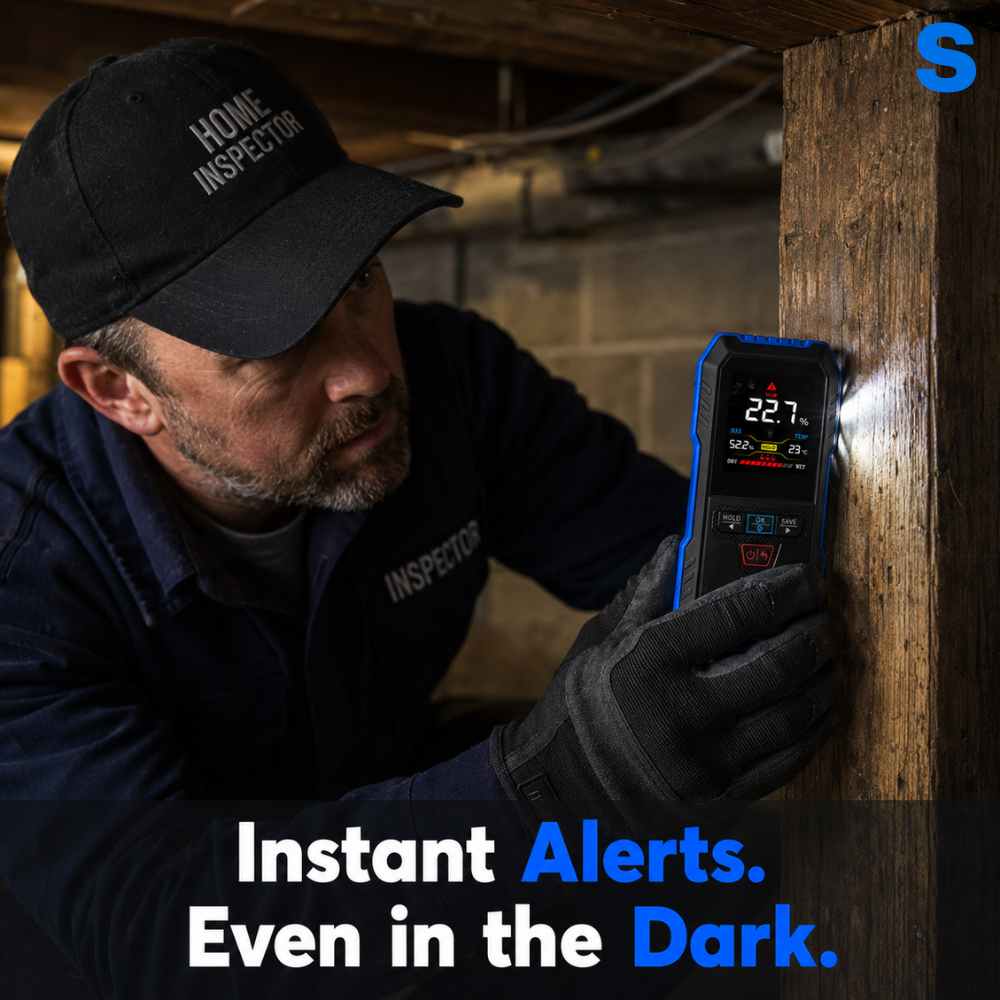
Hand held moisture meter | Calibrated
Hand held moisture meter | Calibrated
☑️ Professional-Grade Accuracy
☑️ Instant Reliable Results
☑️ Catch Hidden Moisture, Save Thousands
☑️ 30-Day Returns
Couldn't load pickup availability
The Handheld Moisture Meter That Reads Four Materials:
Most moisture meters ask you to choose: pin or pinless, wood or wall. The calibrated Hand held moisture meter doesn't make you pick. Grab it, press M to cycle through Wall, Masonry, Soft Wood, or Hard Wood mode, hold the sensor pad flat against the surface, and read. That's the whole workflow , and I've timed it at under eight seconds per scan on a good day.
I keep one clipped inside a tool bag I bring to every renovation walkthrough. Last spring, a client was convinced the musty smell in their guest bedroom was coming from the closet wall. Three scans across the drywall, one more on the pine baseboard: the wall hit 14% (WET range for that mode), the wood stayed dry. Leak confirmed, location pinpointed, no holes drilled, no guesswork.
Four Modes | One Device | No Guesswork, Handheld Moisture Meter:
The reason most generic moisture detectors fail in real conditions is simple: they apply a single moisture scale to every surface. Wood behaves differently than masonry. A 15% reading on a concrete block is unremarkable. That same number in a soft pine stud is a problem.
The WM01 corrects for this with dedicated thresholds per material type:
- Wall: DRY below 8% / MID 8–12% / WET above 12%
- Masonry: DRY below 13% / MID 13–21% / WET above 21%
- Soft Wood: DRY below 20% / MID 20–26% / WET above 26%
- Hard Wood: DRY below 12% / MID 12–16% / WET above 16%

Switch modes with a single button press. The LCD displays your active mode, the numeric reading, and a real-time moisture bar simultaneously , so you never have to mentally convert a raw number into a condition assessment. Green LED means dry. Yellow means investigate. Red with an audible alarm means there's a real moisture issue that needs attention now.
The Handheld Form Factor Is the Feature:
At the size of a TV remote and light enough to forget it's in your hand, the WM01 is designed to be used for extended periods without fatigue. The contoured grip and rear sensor pad mean you scan by pressing , not stabbing, not swabbing, not calibrating between surfaces.
The Data Hold button freezes your last reading on screen, freeing both hands to take notes or photograph the area. Auto-shutoff preserves battery on long days. Mute mode silences the alarm in occupied buildings without disabling any measurement function.
Who Gets the Most Out of This Hand Held Moisture Meter?
Renovation contractors moving between drywall, subfloor, and framing lumber on the same job site , one meter covers every surface without swapping tools or modes mid-task. And if you need a specific product, try the moisture meter for lumber.
Property managers doing seasonal walkthroughs across multiple units, where speed and portability matter more than lab-grade precision and every extra minute costs money.
Serious DIYers tackling a bathroom retile, a basement finishing project, or a firewood storage setup who want to verify conditions once rather than redo work twice like a real moisture meter for wood.
Hand Held Moisture Meter for Every Surface You'll Actually Encounter:
The Calibrated Hand held moisture meter in blue is a handheld moisture meter built around the reality that real buildings contain more than one material type. It fits in a pocket, reads in under ten seconds, and tells you , clearly, loudly if needed , whether a surface is dry, borderline, or wet. No pins. No ambiguity.