


Furniture wood moisture meter
Furniture wood moisture meter
☑️ Professional-Grade Accuracy
☑️ Instant Reliable Results
☑️ Catch Hidden Moisture, Save Thousands
☑️ 30-Day Returns
Couldn't load pickup availability
Mini Furniture Wood Moisture Meter with 8-Material Modes and Reading Lock :
You've spent hours hand-planing a walnut tabletop down to a perfect surface , and one application of finish onto wood that reads 13% MC turns it into a bubbling mess overnight. I've been there. What you need isn't a jobsite meter the size of a TV remote: you need a compact, pocket-sized furniture pin wood moisture meters that lives in your apron and takes a reading in five seconds before you commit to glue, stain, or lacquer.
Never ruin another finish because of a wrong species reading.
- 5-second reading, before you commit : check moisture before glue, stain, or lacquer, not after the bubbling starts.
- 4 wood-type calibrations : no more 3–4% species error sending softwood through a hardwood table.
- 0.10% resolution : see 7.8%, not "8," so you know exactly when a board is ready.
- 9.8mm pins reach the core : catch moisture hiding under the dried shell of 4/4 and 8/4 stock.
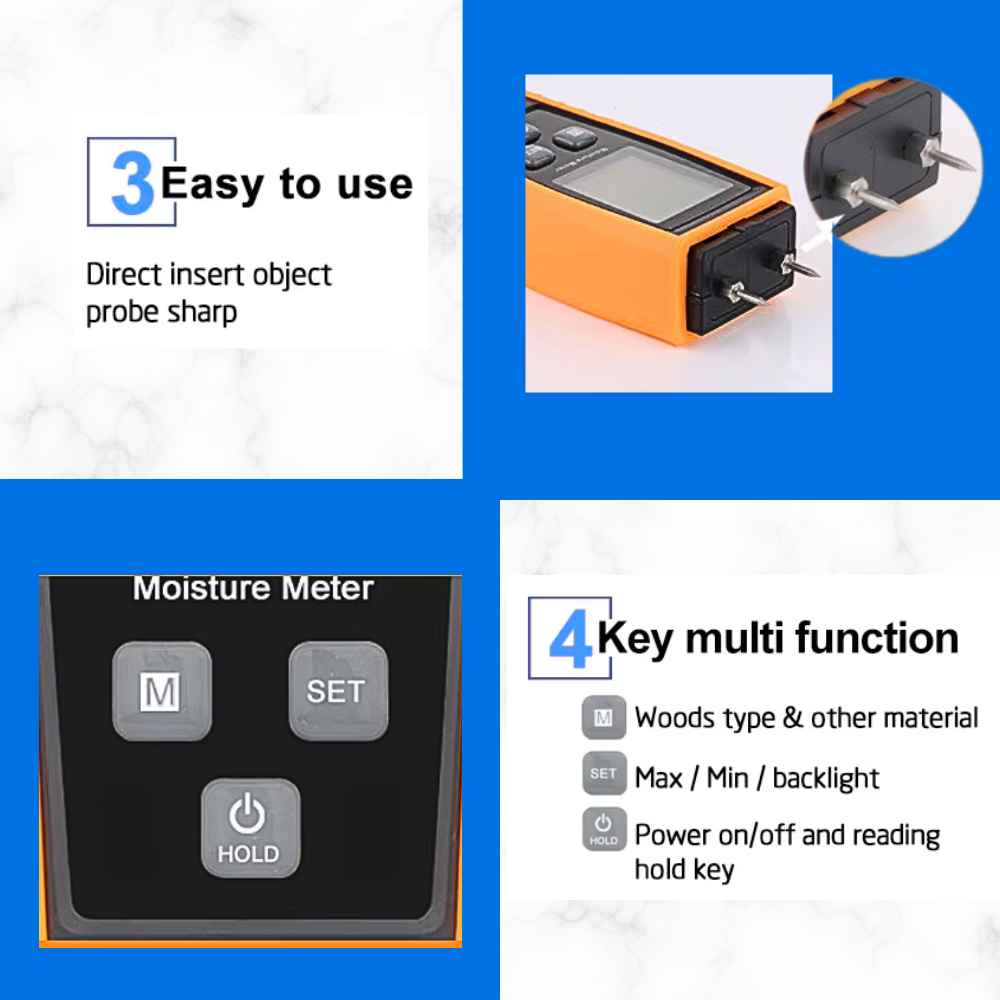
- Hold & recall the reading : freeze the number, log Min/Max across a whole bundle, never lose a reading mid-note.
- Pocket-sized, apron-ready : 8 material modes in a tool that actually fits in your workshop routine.
What makes this meter different for furniture work:
Most moisture meters in this price tier give you a single wood calibration and call it done. This one ships with four distinct wood-type calibration groups , covering everything from dense hardwoods down to softwood stock , plus four additional material modes (Karstenite, cement mortar, lime mortar, and brick). If your workshop feeds raw slabs from a concrete-floored kiln room, you can check the slab and the slab storage surface in the same pocket pull.
- Backlit LCD, non-parallax: Read the display at any angle in a dim finishing room without squinting or repositioning. The large digit layout means no mis-reading 8.0 as 3.0 under workshop lighting.
- Battery alert + auto shutoff: The meter warns you before a low battery skews readings. Auto shutoff preserves the 3× AAA cells between sessions , no dead meter mid-batch.
Who reaches for the Furniture wood moisture meter ?
Furniture makers and woodworkers checking lumber before final dimensioning , particularly those sourcing air-dried slabs where moisture gradients between the face and the core routinely differ by 3–5 points. Small-shop cabinet builders who also work in spaces with concrete floors or masonry walls benefit from the four additional material modes: you can verify the slab storage area isn't wicking moisture back into your stock without swapping tools. At 9.8mm pin depth, it reads deep enough to catch core moisture in furniture-dimension stock (4/4 and 8/4) rather than sampling only the dried shell.
Stop committing to finish before you have a real MC number. This furniture wood moisture meter , with its 0.10% resolution and four wood-calibration modes , gives you the data to make that call with confidence, not intuition. Add it to your apron and never second-guess a board again. And if you need to discover more model, check our lumber moisture meters
Share


FAQ - Moisture Meters
What is a moisture meter and what does it actually measure ?
A moisture meter is a handheld electronic instrument that quantifies the water content held within a solid material. Readings appear as % MC (moisture content) the ratio of water mass to the material's dry mass or as % WME (wood moisture equivalent), a normalized scale that converts non-wood readings to an equivalent wood reference for cross-material comparison.
SensoraHome meters cover ranges from 0–53% MC on wood and 0–99% on other building materials depending on the model and mode selected.
Pro tip
Always confirm your meter is in the correct calibration mode for the material you're testing. A wood-mode reading on drywall will not produce accurate absolute numbers.
What is the difference between a pin-type and a pinless moisture meter?
Pin-type meters drive two electrode pins into the surface to complete a low-voltage circuit. The meter calculates % MC from electrical resistance at the exact depth of insertion typically ¼" to 1". They leave two small marks and are the right tool when depth precision matters: thick lumber, dense hardwoods, or confirming that surface drying has reached the core.
Pinless meters project an electromagnetic field into the material without any surface contact. The meter detects moisture by how much the field return signal deviates from a dry-material baseline, averaging moisture across a scan footprint of several square inches to a depth of ¾"–1.5". They cover large surfaces fast with zero marks ideal for finished floors, tile, drywall, and wall surveys.
Most professional workflows combine both: pinless to scan and flag anomalies, pin to confirm depth and severity.
What does % WME mean on my moisture meter display?
% WME (Wood Moisture Equivalent) is a normalized reference scale that converts non-wood material readings into an equivalent wood moisture number useful when you need to compare readings across different materials on a single consistent display.
It does not mean the material is wood or that the reading reflects wood moisture specifically. It is a relative comparison tool, not an absolute measurement mode. For accurate absolute readings on drywall, concrete, or masonry, your meter must be set to the correct calibration mode for that specific material.