


Firewood Moisture Meter Seasoning Checker
Firewood Moisture Meter Seasoning Checker
☑️ Professional-Grade Accuracy
☑️ Instant Reliable Results
☑️ Catch Hidden Moisture, Save Thousands
☑️ 30-Day Returns
Couldn't load pickup availability
Firewood Moisture Meter That Tells You Exactly When Your Wood Is Ready to Burn:
You've stacked a full cord of oak since last spring, and now that November cold is hitting, you're not sure it's actually seasoned enough to burn clean. Wet firewood over 25% moisture content smokes heavily, creosotes your flue, and delivers a fraction of the heat of properly dried wood , yet most people load the stove on instinct alone.
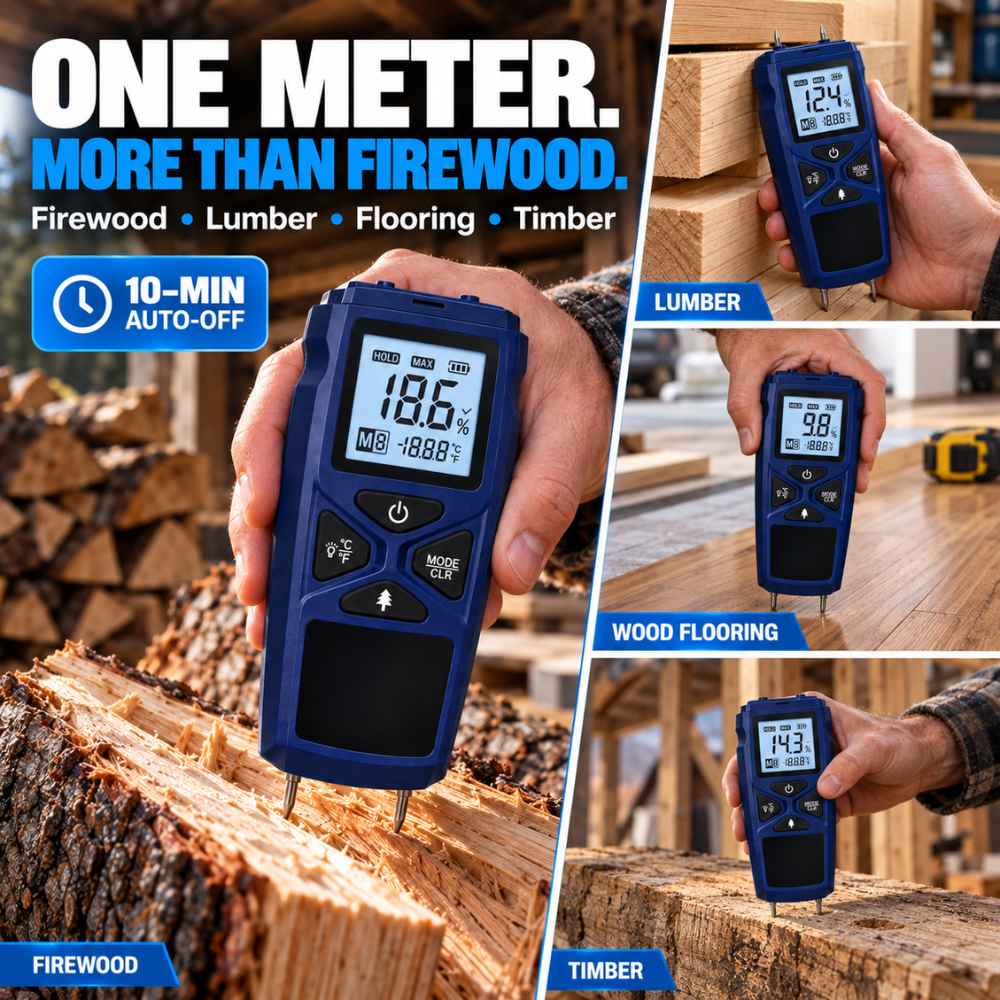
The Firewood Moisture Meter Seasoning Checker takes the guesswork out of seasoning checks with four calibration modes covering over 50 common wood species, giving you a real number instead of a shrug. Discover more wood moisture meters here.
Why this seasoning checker Delivers More Than a Basic Firewood Moisture Meter:
Most single-mode moisture meters treat all firewood the same, which leads to 5–10% reading errors when you switch from pine kindling to dense hardwoods like hickory or white oak. The Firewood Moisture Meter Seasoning Checker four calibration groups (A, B, C, D) account for density differences across softwoods, hardwoods, and exotic species , so whether you're testing a split of Douglas fir or a round of cherry, you're reading actual moisture content, not a density-skewed estimate.
The 0–99.9% measurement range with ±0.5% accuracy catches the critical thresholds that matter for firewood use. There's a meaningful difference between 18% (clean-burning, stove-ready) and 25% (still too wet, needs more time on the stack). The Hold function locks your reading after pulling the pins out, which is genuinely useful when you're checking wood stacked deep against a wall or in a low-clearance shed corner.
Key Specifications That Matter for Seasoning Checks:
- Four Calibration Modes: Groups A–D cover 50+ species from softwood pine to hardwood oak and maple, eliminating the density errors that make single-mode budget meters unreliable for mixed firewood stacks.
- 15-Minute Auto Shutoff: Preserves the 9V battery during a full stack inspection where you're testing dozens of splits across multiple rows.
- 0–99.9% Range: Reads freshly cut green wood just as reliably as nearly-seasoned splits, so you can track drying progress over weeks or months.
Perfect for Firewood Stackers, Stove Owners, and Off-Grid Heating:
Homeowners running a wood stove or fireplace insert as a primary heat source can use this firewood moisture meter before every load , knowing you're at or below 20% means cleaner combustion, less creosote buildup, and more heat per split. Firewood sellers checking customer-ready stock will appreciate the species-specific calibration when moving between mixed hardwood loads. And if you're burning reclaimed lumber or pallet wood in an outdoor fire pit, the extended measurement range confirms you're not about to combust treated or chemically preserved material by mistake.
At this price point, it makes sense to keep one in the woodshed year-round.
Stop stacking wood and hoping for the best. The seasoning checker moisture meter gives you a calibrated seasoning reading across dozens of species in under three seconds , so your firewood is ready when the temperature drops.
Share


FAQ - Moisture Meters
What is a moisture meter and what does it actually measure ?
A moisture meter is a handheld electronic instrument that quantifies the water content held within a solid material. Readings appear as % MC (moisture content) the ratio of water mass to the material's dry mass or as % WME (wood moisture equivalent), a normalized scale that converts non-wood readings to an equivalent wood reference for cross-material comparison.
SensoraHome meters cover ranges from 0–53% MC on wood and 0–99% on other building materials depending on the model and mode selected.
Pro tip
Always confirm your meter is in the correct calibration mode for the material you're testing. A wood-mode reading on drywall will not produce accurate absolute numbers.
What is the difference between a pin-type and a pinless moisture meter?
Pin-type meters drive two electrode pins into the surface to complete a low-voltage circuit. The meter calculates % MC from electrical resistance at the exact depth of insertion typically ¼" to 1". They leave two small marks and are the right tool when depth precision matters: thick lumber, dense hardwoods, or confirming that surface drying has reached the core.
Pinless meters project an electromagnetic field into the material without any surface contact. The meter detects moisture by how much the field return signal deviates from a dry-material baseline, averaging moisture across a scan footprint of several square inches to a depth of ¾"–1.5". They cover large surfaces fast with zero marks ideal for finished floors, tile, drywall, and wall surveys.
Most professional workflows combine both: pinless to scan and flag anomalies, pin to confirm depth and severity.
What does % WME mean on my moisture meter display?
% WME (Wood Moisture Equivalent) is a normalized reference scale that converts non-wood material readings into an equivalent wood moisture number useful when you need to compare readings across different materials on a single consistent display.
It does not mean the material is wood or that the reading reflects wood moisture specifically. It is a relative comparison tool, not an absolute measurement mode. For accurate absolute readings on drywall, concrete, or masonry, your meter must be set to the correct calibration mode for that specific material.