


Carpet moisture meter | DampTrace
Carpet moisture meter | DampTrace
☑️ Professional-Grade Accuracy
☑️ Instant Reliable Results
☑️ Catch Hidden Moisture, Save Thousands
☑️ 30-Day Returns
Couldn't load pickup availability
Carpet Moisture Meter That Catches Sub-Surface Saturation Before the Damage Starts:
You pull back a corner of carpet after a slow leak report. The pad looks dry. The subfloor looks fine. You've been here before, and you've been wrong before. That's the exact moment this tool earns its place in your kit.
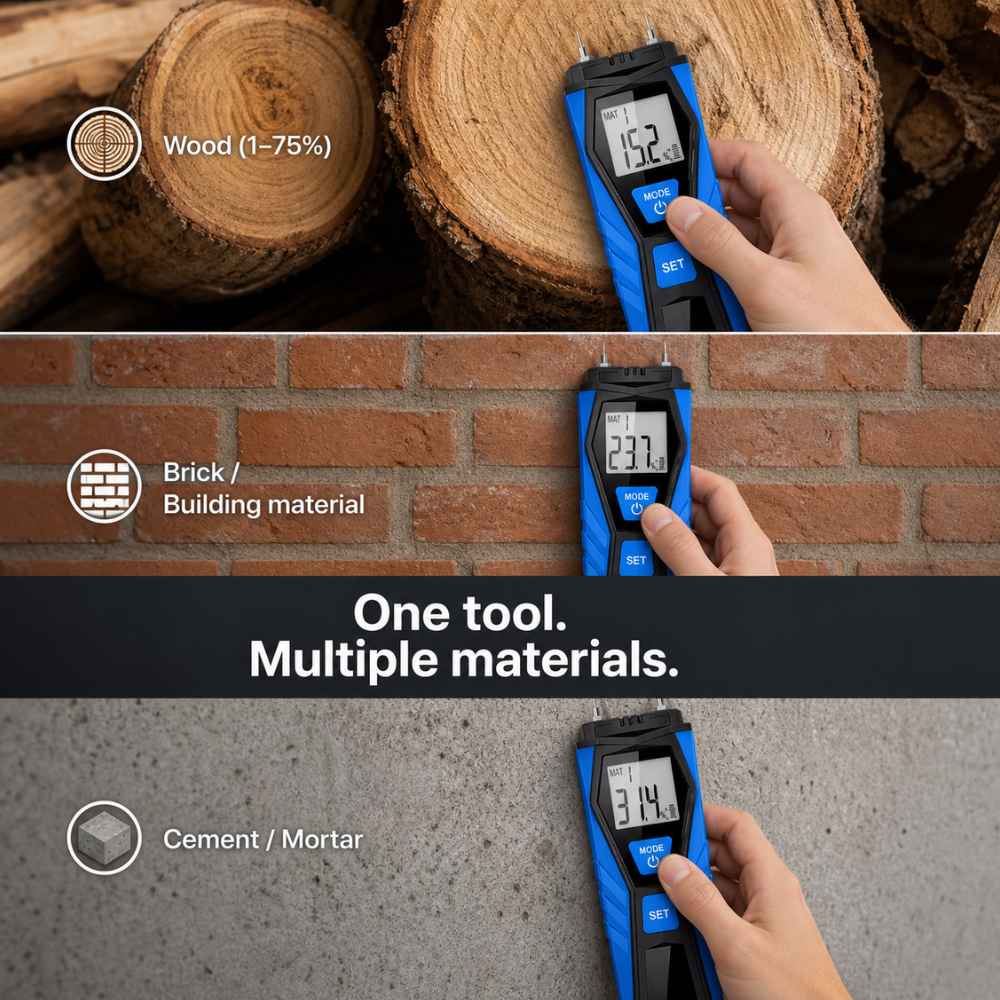
| Material | Measuring Range | Resolution | Error Margin |
|---|---|---|---|
| Wood | 1 – 75% | 0.1% | ±5% (1–75%) |
| Building Material | 0.1 – 2.4% | 0.1% | / |
| Ambient Temperature | -10 – 60°C / °F switchable | 0.1°C | ±1% (0–45°C) / ±1.5% (outside range) |
| Ambient Relative Humidity | 0 – 100% RH | 1% RH | ±4.0% RH (20–80%) / ±5.0% RH (outside range) |
Measuring range: 1 – 75%
Resolution: 0.1%
Error margin: ±5% (1–75%)
Measuring range: 0.1 – 2.4%
Resolution: 0.1%
Error margin: —
Measuring range: -10 – 60°C / °F switchable
Resolution: 0.1°C
Error margin: ±1% (0–45°C) / ±1.5% (outside range)
Measuring range: 0 – 100% RH
Resolution: 1% RH
Error margin: ±4.0% RH (20–80%) / ±5.0% RH (outside range)
Step 1 | First contact: the carpet surface: Press the 303 stainless steel pins into the carpet pile. At a 0.5-second sampling rate, you get a reading before you've shifted your weight. The wood scale (1–75%) gives you a comparable baseline; any reading above the datum point you've verified on the instrument cover tells you moisture is present, not just suspected.
Step 2 | Ambient cross-check: Before logging your result, one press of the MODE button pulls up the room's ambient temperature and relative humidity (0–100% RH, ±4.0% in the 20–80% range). This matters because a carpet reading of 18% in a 75% RH room tells a different story than the same reading in a dry basement. Without that environmental context, you're documenting a number, not a condition.
Step 3 | Subfloor and base material scan: Switch to building material mode (0.1–2.4%). Same probe, same device. You're now checking the concrete slab or wood subfloor beneath. The ±5% error margin on the wood scale is honest, this isn't a lab instrument, but for triage decisions on a water-damage job, it's the margin that separates "pull it now" from "monitor and return."
Step 4 | Documentation and handoff: The HD LCD backlit display reads cleanly in crawl-space lighting or under dim emergency conditions. At 90g with a protective cap, it fits in a back pocket between rooms.
One limitation worth noting: the 10mm electrode depth is suited for carpet and soft flooring, not thick hardwood planks where deeper pin penetration matters.
A carpet moisture meter that also logs ambient conditions removes the single biggest gap in water-damage triage, context. Stop documenting numbers. Start documenting conditions. And if you need a all-in-one detector, try one of our drywall moisture meter.
Share


FAQ - Moisture Meters
What is a moisture meter and what does it actually measure ?
A moisture meter is a handheld electronic instrument that quantifies the water content held within a solid material. Readings appear as % MC (moisture content) the ratio of water mass to the material's dry mass or as % WME (wood moisture equivalent), a normalized scale that converts non-wood readings to an equivalent wood reference for cross-material comparison.
SensoraHome meters cover ranges from 0–53% MC on wood and 0–99% on other building materials depending on the model and mode selected.
Pro tip
Always confirm your meter is in the correct calibration mode for the material you're testing. A wood-mode reading on drywall will not produce accurate absolute numbers.
What is the difference between a pin-type and a pinless moisture meter?
Pin-type meters drive two electrode pins into the surface to complete a low-voltage circuit. The meter calculates % MC from electrical resistance at the exact depth of insertion typically ¼" to 1". They leave two small marks and are the right tool when depth precision matters: thick lumber, dense hardwoods, or confirming that surface drying has reached the core.
Pinless meters project an electromagnetic field into the material without any surface contact. The meter detects moisture by how much the field return signal deviates from a dry-material baseline, averaging moisture across a scan footprint of several square inches to a depth of ¾"–1.5". They cover large surfaces fast with zero marks ideal for finished floors, tile, drywall, and wall surveys.
Most professional workflows combine both: pinless to scan and flag anomalies, pin to confirm depth and severity.
What does % WME mean on my moisture meter display?
% WME (Wood Moisture Equivalent) is a normalized reference scale that converts non-wood material readings into an equivalent wood moisture number useful when you need to compare readings across different materials on a single consistent display.
It does not mean the material is wood or that the reading reflects wood moisture specifically. It is a relative comparison tool, not an absolute measurement mode. For accurate absolute readings on drywall, concrete, or masonry, your meter must be set to the correct calibration mode for that specific material.