


Bathroom moisture meter | TileProbe
Bathroom moisture meter | TileProbe
☑️ Professional-Grade Accuracy
☑️ Instant Reliable Results
☑️ Catch Hidden Moisture, Save Thousands
☑️ 30-Day Returns
Couldn't load pickup availability
Bathroom Moisture Meter That Finds the Leak Before You Smash the Tile:
The worst part of a bathroom leak isn't the water, it's not knowing where it's actually coming from. Is it the supply line behind the vanity? The shower pan seal? A hairline crack in the grout three feet up the wall? Without a number, you're either opening up everything or ignoring a problem that's quietly rotting the framing behind your porcelain.
A bathroom moisture meter with a spherical ball sensor changes that calculation entirely. Instead of guessing or demo-ing, you run the probe along the tile surface, grout lines, and baseboard caulk until the reading spikes, and that spike tells you exactly where to cut.
| Material | Display Value | Moisture Content |
|---|---|---|
| Gypsum (Mineral) | < 30 | DRY |
| 30 ~ 60 | MID | |
| > 60 | WET | |
| Cement | < 25 | DRY |
| 25 ~ 50 | MID | |
| > 50 | WET | |
| Wood | < 50 | DRY |
| 50 ~ 80 | MID | |
| > 80 | WET |
The TileProbe Detector Built for the Specific Problem of Bathrooms:
Bathroom environments are hard on moisture detection, that why you need a good detector like the Tileprobe or the best concrete moisture meter. You're dealing with stacked materials, tile bonded to cement board bonded to drywall, plus residual surface humidity from daily showers that can throw off a less precise instrument. This detector addresses that directly:
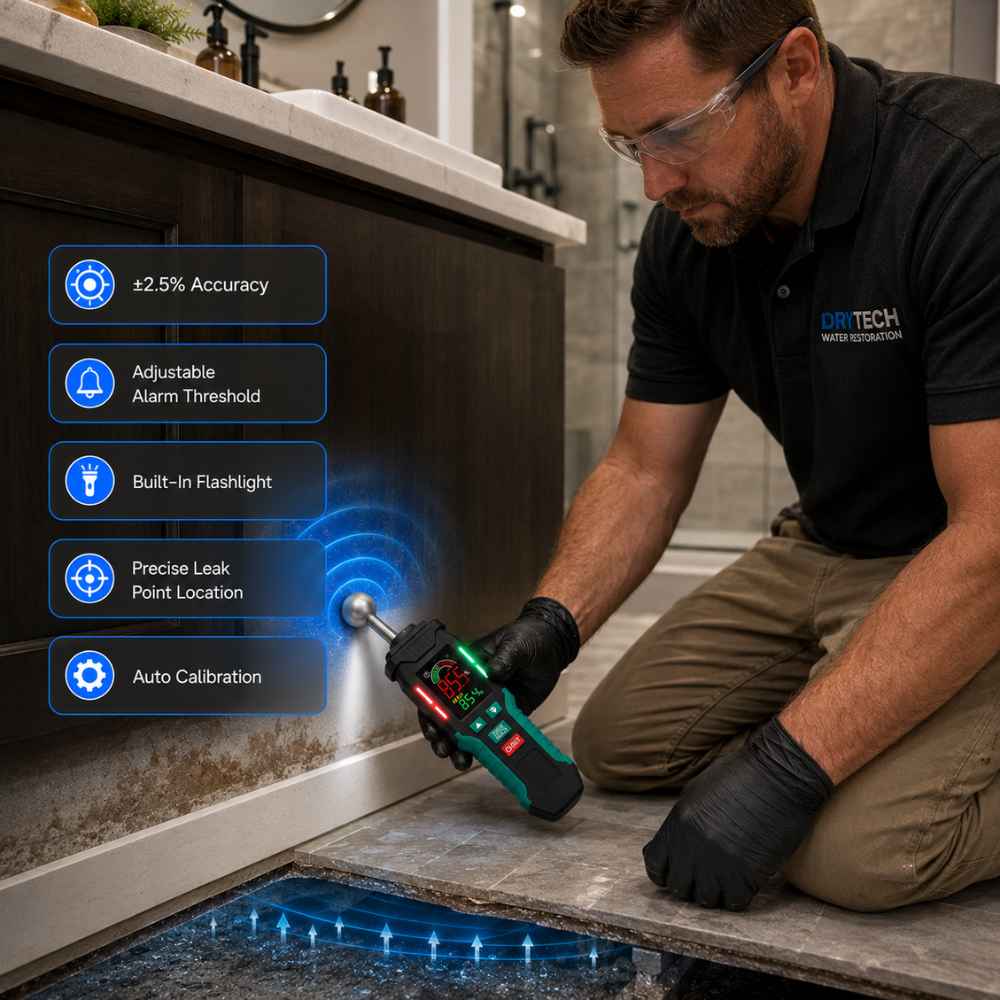
- ±2.5% accuracy, distinguishes genuine subsurface water intrusion (WET: >60 on gypsum) from normal post-shower humidity that dissipates within hours
- 40mm detection depth, reaches past the tile and adhesive bed into the cement board and drywall cavity where slow pipe leaks accumulate over weeks
- Auto calibration, resets the baseline when moving from a tiled section to an adjacent drywall panel without manual adjustment between each surface change
- Adjustable alarm threshold, water restoration technicians diagnosing active leaks in occupied bathrooms can set a tighter WET trigger to catch borderline readings before they become mold conditions
- Built-in flashlight, illuminates under vanity bases, inside shower enclosure corners, and behind toilet tanks without a second person holding a light
- Zero/Hold function, locks the peak reading at a suspect point for documentation before repositioning
Situation Where you really need the TileProbe moisture meter:
Shower wall leak tracing: A remediation tech scanning a master bath with recurring grout staining glides the ball sensor vertically from the shower floor up to head height, the reading climbs from 22 to 87 at a single grout joint, pinpointing a cracked waterproof membrane behind the tile at knee level. One targeted cut instead of a full wall demo.
Vanity base moisture check: A bathroom remodeler pulling old cabinetry uses it to confirm whether the subfloor under the vanity base has absorbed water from a slow drain leak, cement readings above 50 flag a replacement before the new cabinet goes in over a damaged substrate.
Routine homeowner inspection: A homeowner who noticed a soft spot in the baseboard paint runs the detector along the tub surround caulk line, a reading of 71 on the gypsum scale confirms active intrusion at the tub-wall transition, not just cosmetic discoloration.
TileProbe Know exactly where the problem is before you touch a single tile:
This bathroom moisture detector gives water restoration professionals and thorough homeowners alike the precision to locate hidden leaks in minutes, and the documentation to justify every repair decision with a real number.
Share


FAQ - Moisture Meters
What is a moisture meter and what does it actually measure ?
A moisture meter is a handheld electronic instrument that quantifies the water content held within a solid material. Readings appear as % MC (moisture content) the ratio of water mass to the material's dry mass or as % WME (wood moisture equivalent), a normalized scale that converts non-wood readings to an equivalent wood reference for cross-material comparison.
SensoraHome meters cover ranges from 0–53% MC on wood and 0–99% on other building materials depending on the model and mode selected.
Pro tip
Always confirm your meter is in the correct calibration mode for the material you're testing. A wood-mode reading on drywall will not produce accurate absolute numbers.
What is the difference between a pin-type and a pinless moisture meter?
Pin-type meters drive two electrode pins into the surface to complete a low-voltage circuit. The meter calculates % MC from electrical resistance at the exact depth of insertion typically ¼" to 1". They leave two small marks and are the right tool when depth precision matters: thick lumber, dense hardwoods, or confirming that surface drying has reached the core.
Pinless meters project an electromagnetic field into the material without any surface contact. The meter detects moisture by how much the field return signal deviates from a dry-material baseline, averaging moisture across a scan footprint of several square inches to a depth of ¾"–1.5". They cover large surfaces fast with zero marks ideal for finished floors, tile, drywall, and wall surveys.
Most professional workflows combine both: pinless to scan and flag anomalies, pin to confirm depth and severity.
What does % WME mean on my moisture meter display?
% WME (Wood Moisture Equivalent) is a normalized reference scale that converts non-wood material readings into an equivalent wood moisture number useful when you need to compare readings across different materials on a single consistent display.
It does not mean the material is wood or that the reading reflects wood moisture specifically. It is a relative comparison tool, not an absolute measurement mode. For accurate absolute readings on drywall, concrete, or masonry, your meter must be set to the correct calibration mode for that specific material.