


Bamboo moisture meter | FloorGuard
Bamboo moisture meter | FloorGuard
☑️ Professional-Grade Accuracy
☑️ Instant Reliable Results
☑️ Catch Hidden Moisture, Save Thousands
☑️ 30-Day Returns
Couldn't load pickup availability
Why Bamboo Flooring Fails Before the First Year Ends?
Bamboo is one of the most dimensionally reactive flooring materials a contractor or serious DIYer will ever install. At 19% moisture content, a plank that looks perfectly flat on delivery will cup, crown, or separate from its neighbor within six months of going down, and no amount of re-nailing fixes expansion that is already locked into the fiber.
The mistake is almost never a bad batch of flooring, it is installing before the material and the subfloor environment have been verified together. A visual check tells you nothing. A single reading from a DC resistance pin probe, pressed into the surface and read against a bamboo-calibrated scale, tells you whether the job can start.
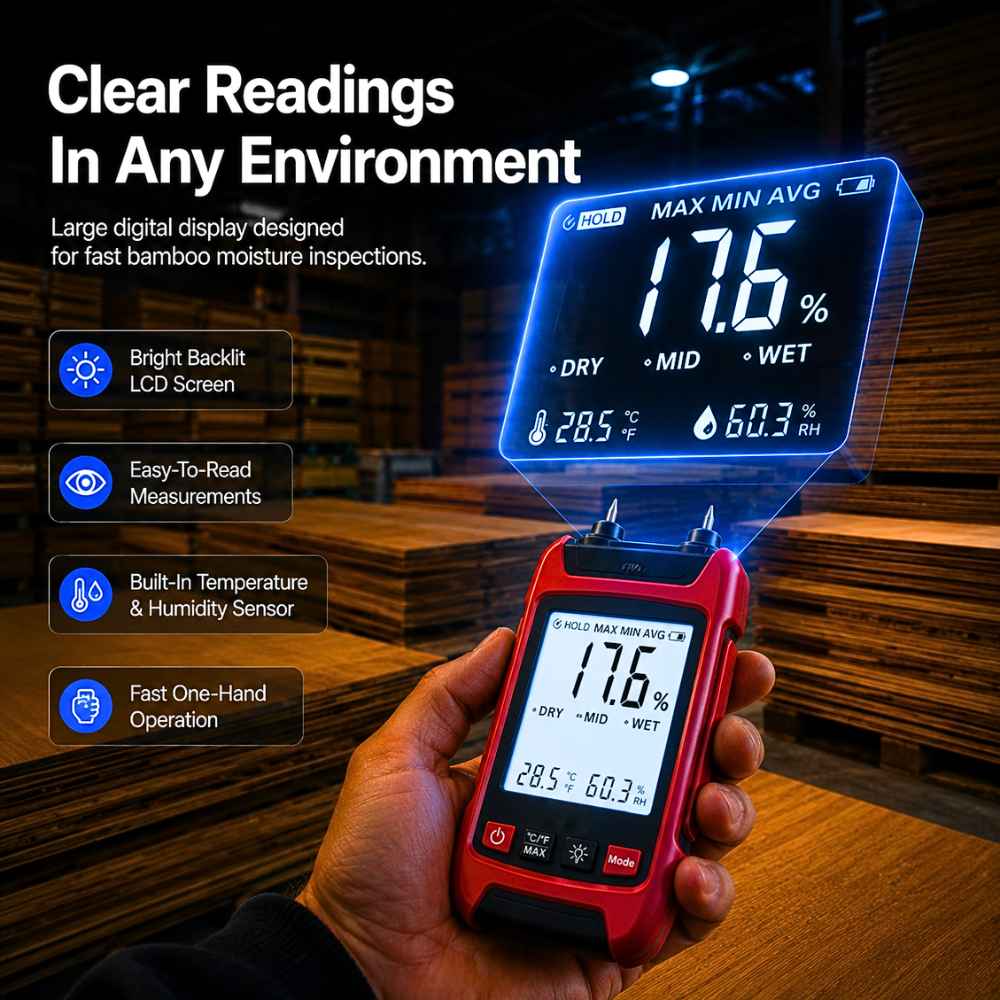
The FloorGuard bamboo moisture meter measures moisture content from 0 to 99.9%, covering the full range from kiln-dried stock to water-damaged panels, with a built-in ambient humidity and temperature sensor that lets you cross-check the room conditions against the material reading on the same screen, without switching instruments or doing mental math.
What You Catch Before Installation
- ● A bamboo plank batch showing a 7-point moisture spread (14% to 21%) across the same delivery pallet, visible on the MIN/MAX display without manual logging
- ● A concrete subfloor reading above 3% MC (mode 3) paired with ambient RH above 65%, confirming the adhesive layer will not cure correctly before flooring goes down
- ● A room temperature below 15°C (visible in °C/°F on the lower display) slowing bamboo acclimation, so the re-check schedule gets adjusted rather than installation starting on the original timeline
- ● Woven-strand bamboo panels stored near an exterior wall reading WET zone while panels stored at center-room read DRY zone, caught in under 5 minutes of cross-floor spot testing
- ● A gypsum screed subfloor (mode 4) that passed a visual dryness check but measured above the threshold for floating floor installation, documented with the HOLD function before the flooring crew arrived
- ● Ambient relative humidity at 20.5% RH in a room with active HVAC, cross-referenced on the same display as the material reading, flagging that the bamboo MC will continue dropping before the 48-hour acclimation window closes
How a Pin Probe Reads Bamboo Fiber the Way a Subfloor Inspector Actually Needs?
DC resistance-type meters work by passing a low current between two stainless pins and measuring the electrical resistance of the material between them, resistance drops as moisture rises, and the meter converts that drop into a direct percentage.
What makes the FloorGuard unit specific to bamboo and structural wood is that it carries seven pre-loaded material calibration profiles covering Beech, Spruce, Larch, Walnut (mode 1), Oak, Maple, Lauan (mode 2), Concrete/Cement sand bed (mode 3), Gypsum mortar layer (mode 4), Cement mortar (mode 5), Lime mortar/gypsum (mode 6), and Brick (mode 7).
This bamboo moisture meter measures material water content across a 0–99.9% range with a high-precision digital sensor, while simultaneously displaying ambient relative humidity up to the 20.5% RH reference point and ambient temperature in either Celsius or Fahrenheit, giving installers a complete site picture without a second instrument.
The third time I pulled a bamboo pallet that had been stored in a garage for two weeks and found readings between 14% and 21% on different planks from the same bundle, I understood why selective testing across a full delivery, not just a corner check, changes the outcome: that 7-point spread would have produced visible gapping at the dry end and swelling at the wet end within one heating season.
Before the Glue Dries, Getting the Reading Right on Every Bamboo Panel:
Bamboo flooring installers who skip pre-installation moisture verification are not cutting corners by choice, they are usually working without a tool that makes the check fast enough to fit into a normal workflow. Testing every fifth plank with a meter that requires two hands, a separate hygrometer, and manual mode switching adds minutes per bundle across a day-long install. With a single instrument that reads material moisture, ambient humidity, and temperature in one screen press, checking a plank takes under 30 seconds and adds nothing to the schedule. For glue-down installations, the subfloor moisture reading matters as much as the bamboo reading; the concrete profile (mode 3) and cement mortar profile (mode 5) cover both scenarios. Any subfloor reading above the adhesive manufacturer's specification, cross-referenced against a room RH above 65%, is a documented reason to delay installation rather than a judgment call. That documentation, saved as a MAX/MIN readout, is also a written record if a flooring warranty claim comes up later.
The Number That Decides Whether the Job Starts or Waits with the moisture meter for bamboo flooring:
Most bamboo flooring warranty guidelines specify installation at a moisture content between 6% and 9%, in rooms held at 35%–65% relative humidity. A reading of 12% on arrival is not a flooring defect, it is a condition that requires re-acclimation, and a meter with an AVG tracking function across 20 planks gives a contractor the precise number to communicate to a client rather than a visual estimate. If the flooring acclimates, the job starts. If the subfloor stays wet, the job waits with a documented reason. Either way, no bamboo floor gets installed at the wrong moisture content and calls back in six months. For installers, renovation contractors, and lumber yard inspectors who work with bamboo panels, structural bamboo board, or woven-strand bamboo material regularly, see the full range of moisture measurement tools on the moisture detector collection and the dedicated wood moisture meter selection on the moisture meter for wood selection.
Share


FAQ - Moisture Meters
What is a moisture meter and what does it actually measure ?
A moisture meter is a handheld electronic instrument that quantifies the water content held within a solid material. Readings appear as % MC (moisture content) the ratio of water mass to the material's dry mass or as % WME (wood moisture equivalent), a normalized scale that converts non-wood readings to an equivalent wood reference for cross-material comparison.
SensoraHome meters cover ranges from 0–53% MC on wood and 0–99% on other building materials depending on the model and mode selected.
Pro tip
Always confirm your meter is in the correct calibration mode for the material you're testing. A wood-mode reading on drywall will not produce accurate absolute numbers.
What is the difference between a pin-type and a pinless moisture meter?
Pin-type meters drive two electrode pins into the surface to complete a low-voltage circuit. The meter calculates % MC from electrical resistance at the exact depth of insertion typically ¼" to 1". They leave two small marks and are the right tool when depth precision matters: thick lumber, dense hardwoods, or confirming that surface drying has reached the core.
Pinless meters project an electromagnetic field into the material without any surface contact. The meter detects moisture by how much the field return signal deviates from a dry-material baseline, averaging moisture across a scan footprint of several square inches to a depth of ¾"–1.5". They cover large surfaces fast with zero marks ideal for finished floors, tile, drywall, and wall surveys.
Most professional workflows combine both: pinless to scan and flag anomalies, pin to confirm depth and severity.
What does % WME mean on my moisture meter display?
% WME (Wood Moisture Equivalent) is a normalized reference scale that converts non-wood material readings into an equivalent wood moisture number useful when you need to compare readings across different materials on a single consistent display.
It does not mean the material is wood or that the reading reflects wood moisture specifically. It is a relative comparison tool, not an absolute measurement mode. For accurate absolute readings on drywall, concrete, or masonry, your meter must be set to the correct calibration mode for that specific material.