


Air moisture meter | DewGuard
Air moisture meter | DewGuard
☑️ Professional-Grade Accuracy
☑️ Instant Reliable Results
☑️ Catch Hidden Moisture, Save Thousands
☑️ 30-Day Returns
Couldn't load pickup availability
What does an air moisture meter actually measure that a standard hygrometer doesn't?
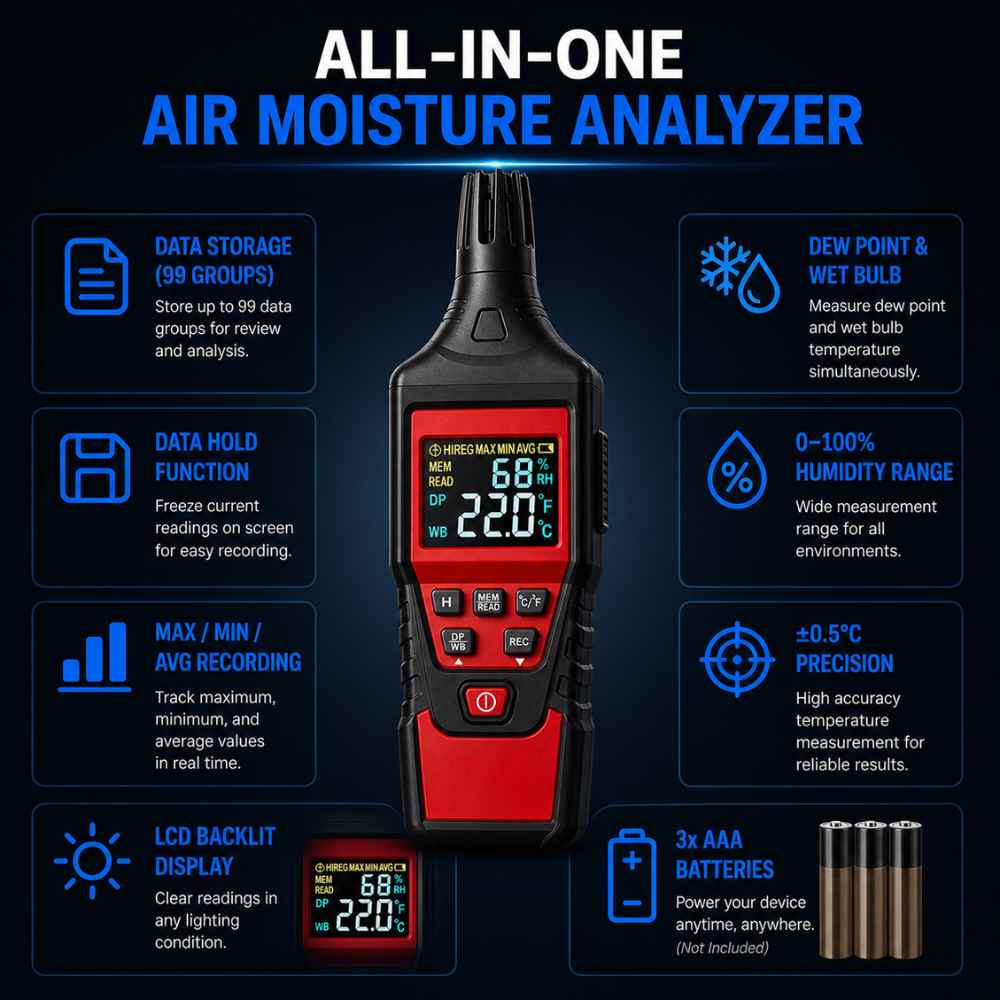
Most hygrometers stop at relative humidity and temperature. The DewGuard goes three readings deeper: ambient humidity (0–100%, ±3.0%), wet bulb temperature, and dew point down to -50°C. That last number is the one HVAC technicians and spray foam installers argue about on job sites. Dew point tells you the exact air temperature at which moisture will condense onto a surface, and condensation is where mold starts, coatings fail, and ductwork corrodes. Relative humidity alone won't give you that threshold. Dew point will.
| Parameter | Range | Resolution | Accuracy |
|---|---|---|---|
| Ambient Temperature | -20°C ~ 60°C (-4.0°F ~ 140°F) | 0.1°C / 0.1°F | ±0.5°C |
| Ambient Humidity | 0 ~ 100% | 0.1% | ±3.0% |
| Wet Bulb Temperature | -20°C ~ 60°C (-4.0°F ~ 140°F) | 0.1°C / 0.1°F | ±0.5°C |
| Dew Point | -50°C ~ 60°C (-58.0°F ~ 140°F) | 0.1°C / 0.1°F | ±0.5°C |
| Data Memory | 99 groups | ||
| Data Hold / Max / Min / Average | Yes | ||
| °C / °F Switch | Yes | ||
| Auto Power Off | 30 minutes | ||
| Low Battery Indication | Yes | ||
| Power | 3 × 1.5V AAA batteries (not included) | ||
| Weight | approx. 190g | ||
| Dimensions | 180 × 60 × 33 mm | ||
Range: -20°C ~ 60°C (-4.0°F ~ 140°F)
Resolution: 0.1°C / 0.1°F
Accuracy: ±0.5°C
Range: 0 ~ 100%
Resolution: 0.1%
Accuracy: ±3.0%
Range: -20°C ~ 60°C (-4.0°F ~ 140°F)
Resolution: 0.1°C / 0.1°F
Accuracy: ±0.5°C
Range: -50°C ~ 60°C (-58.0°F ~ 140°F)
Resolution: 0.1°C / 0.1°F
Accuracy: ±0.5°C
Data memory: 99 groups
Data hold / Max / Min / Average: Yes
°C / °F switch: Yes
Auto power off: 30 minutes
Low battery indication: Yes
Power: 3 × 1.5V AAA batteries (not included)
Weight: approx. 190g
Dimensions: 180 × 60 × 33 mm
Who actually needs wet bulb temperature from an air moisture meter?
The technician commissioning a commercial kitchen's ventilation system in a Gulf Coast state in August. Wet bulb temperature, measured here at ±0.5°C resolution, determines real-world cooling load in high-humidity environments. Without it, you're sizing equipment on dry numbers that don't reflect the latent heat burden in the air. I've watched contractors underspec exhaust systems for exactly this reason: they had humidity, they didn't have wet bulb.
How do you track readings across a multi-room inspection?
The DewGuard Air moisture meter stores 99 data groups with Max/Min and Average functions. In practice: walk each room, log a reading, and pull the average at the end rather than relying on memory or handwritten notes. Auto power-off kicks in at 30 minutes, long enough for a thorough survey, conservative enough to protect the AAA batteries that aren't included.
What's the honest limitation of the Air moisture meter?
This is an air measurement device. It reads the atmosphere in a space, not the moisture content inside walls, wood, or concrete. If you need to probe a material, this isn't the tool. But if your question is "is this room's air creating the conditions for a moisture problem?", the DewGuard Air moisture meter answers that with more precision than any single-metric hygrometer.
For HVAC commissioning, grow room calibration, or any environment where air moisture conditions determine what happens to surfaces over time, this air moisture meter gives you the full atmospheric picture in one 190g instrument. And if you need a specific sensor, you can check our selection of wall moisture meters to control your home.
Share


FAQ - Moisture Meters
What is a moisture meter and what does it actually measure ?
A moisture meter is a handheld electronic instrument that quantifies the water content held within a solid material. Readings appear as % MC (moisture content) the ratio of water mass to the material's dry mass or as % WME (wood moisture equivalent), a normalized scale that converts non-wood readings to an equivalent wood reference for cross-material comparison.
SensoraHome meters cover ranges from 0–53% MC on wood and 0–99% on other building materials depending on the model and mode selected.
Pro tip
Always confirm your meter is in the correct calibration mode for the material you're testing. A wood-mode reading on drywall will not produce accurate absolute numbers.
What is the difference between a pin-type and a pinless moisture meter?
Pin-type meters drive two electrode pins into the surface to complete a low-voltage circuit. The meter calculates % MC from electrical resistance at the exact depth of insertion typically ¼" to 1". They leave two small marks and are the right tool when depth precision matters: thick lumber, dense hardwoods, or confirming that surface drying has reached the core.
Pinless meters project an electromagnetic field into the material without any surface contact. The meter detects moisture by how much the field return signal deviates from a dry-material baseline, averaging moisture across a scan footprint of several square inches to a depth of ¾"–1.5". They cover large surfaces fast with zero marks ideal for finished floors, tile, drywall, and wall surveys.
Most professional workflows combine both: pinless to scan and flag anomalies, pin to confirm depth and severity.
What does % WME mean on my moisture meter display?
% WME (Wood Moisture Equivalent) is a normalized reference scale that converts non-wood material readings into an equivalent wood moisture number useful when you need to compare readings across different materials on a single consistent display.
It does not mean the material is wood or that the reading reflects wood moisture specifically. It is a relative comparison tool, not an absolute measurement mode. For accurate absolute readings on drywall, concrete, or masonry, your meter must be set to the correct calibration mode for that specific material.