


Moisture meter for tile | Rechargeable
Moisture meter for tile | Rechargeable
☑️ Professional-Grade Accuracy
☑️ Instant Reliable Results
☑️ Advanced Sensor Technology
☑️ 30-Day Money-Back Guarantee
Couldn't load pickup availability
Customer Protection
- 🔒 Secure Payments PCI-compliant & fraud protected
- 🛡️ SSL Encrypted Checkout Your data is always safe with us
- ↩️ 30-Day Returns Simple & transparent returns
- 💬 Trusted Support Real help from our team
Pinless Moisture Meter for Tile Installations , Read 20–40mm Deep Without a Single Hole:
Tile setters and flooring contractors know the frustration: you've just laid a full run of porcelain over a cementitious substrate, and days later the adhesive fails. Nine times out of ten, residual moisture in the slab was the culprit , moisture you never measured because drilling test holes mid-job felt impractical. The moisture meter for tile spherical inductive moisture meter was built specifically to eliminate that blind spot.
| Materials | Display value | Moisture content grade |
|---|---|---|
| Gypsum (minerals) |
<30 | DRY |
| 30~60 | RISK | |
| >60 | WET | |
| Cementitious substrate |
<25 | DRY |
| 25~50 | RISK | |
| >50 | WET | |
| Wood | <50 | DRY |
| 50~80 | RISK | |
| >80 | WET |
Why This Pinless Moisture Meter for tile Stands Out for Tile Work?
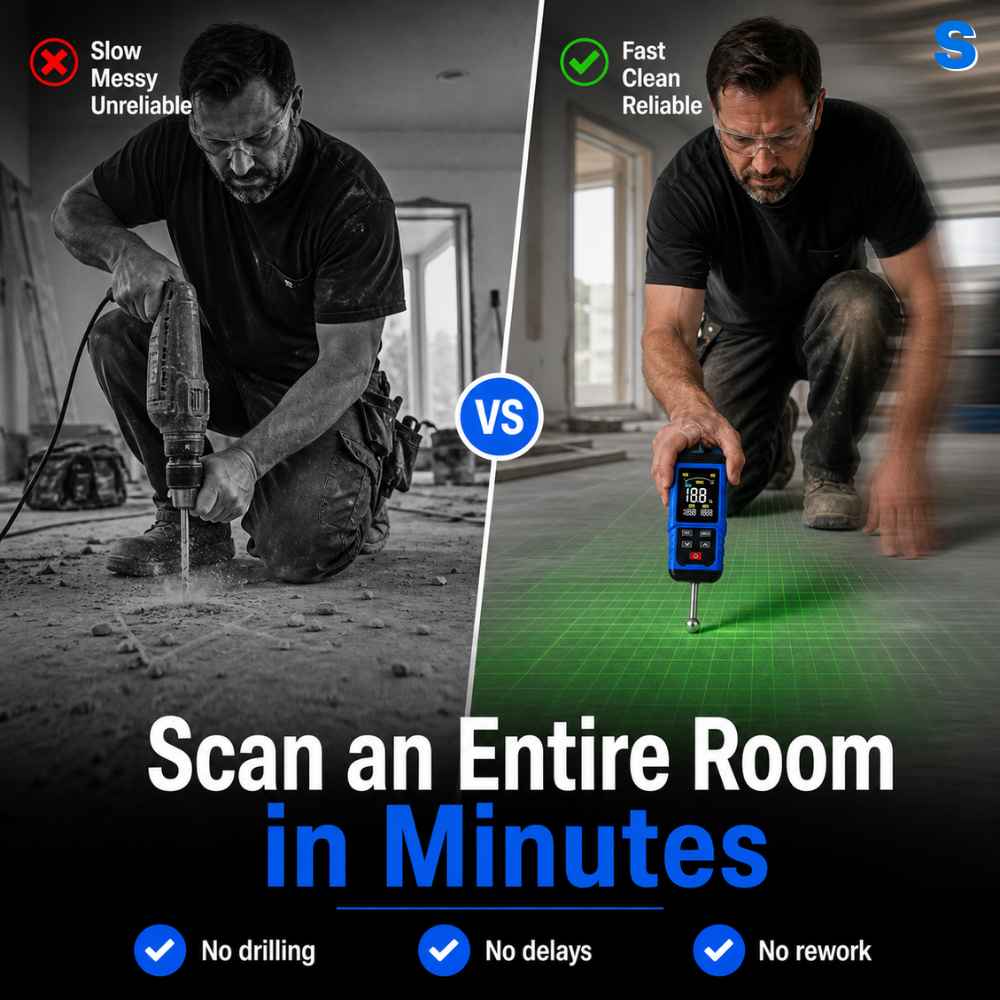
Most pin-type moiture meters stop at the surface. This device uses spherical inductive technology to penetrate 20 to 40mm below the material surface , deep enough to reach the adhesive bond layer beneath tile, without touching it. No probes, no electrode holes, no surface damage.
The color LCD display doesn't just show a number , it gives you an instant moisture grade: DRY, RISK, or WET, color-coded in green, yellow, and red. For cementitious substrates specifically, readings below 25 are classified DRY, 25–50 as RISK, and above 50 as WET. That means your crew gets a clear go/no-go call on the floor, not a raw figure they have to interpret under a deadline.
Accuracy sits at ±2.5% at 25°C ±2°C , tight enough for pre-installation substrate assessment where overestimates kill timelines and underestimates kill tile jobs.
Key That Matter for Substrate Scanning with this rechargeable meter:
- Measurement range: SK-7303 covers 0–100% (ideal for broad substrate surveys); SK-7305 covers 0–52% with 4 adjustable density settings (0.5–3.0 g/cm³), critical when working with varying concrete mixes or lightweight screeds
- Non-destructive scanning: no pins means no micro-fractures in finished or curing substrates
- Auto-calibration on startup: the meter self-calibrates every time you press Measure , no manual zeroing between rooms
- Data retention + Hold function: lock a reading while you photograph the zone or mark the floor , no transcription errors on large site surveys
- Material limitation: will not read correctly through metal-reinforced substrates , keep this in mind on heated floor systems with embedded elements
Perfect for Tile & Renovation Contractors Diagnosing Wet Slabs:
I used this exact meter on a bathroom renovation where the client had already experienced one failed tile installation from a previous contractor. Before laying anything, I scanned the entire 12m² cementitious floor in under four minutes , moving the meter continuously while watching the color bar shift zone by zone. Two corners registered RISK. We waited five days, rescanned, confirmed DRY across the board, and tiled. Eighteen months later, zero callbacks.
Beyond tile prep, this meter is equally suited to:
- Post-flood remediation crews scanning plaster and masonry walls for hidden moisture pockets before repainting
- Property inspectors checking cementitious substrates in basements and utility rooms without disturbing finished surfaces
- HVAC installers verifying drywall moisture levels around duct penetrations before sealing
Share


FAQ - Moisture Meters
What is a moisture meter and what does it actually measure ?
A moisture meter is a handheld electronic instrument that quantifies the water content held within a solid material. Readings appear as % MC (moisture content) the ratio of water mass to the material's dry mass or as % WME (wood moisture equivalent), a normalized scale that converts non-wood readings to an equivalent wood reference for cross-material comparison.
SensoraHome meters cover ranges from 0–53% MC on wood and 0–99% on other building materials depending on the model and mode selected.
Pro tip
Always confirm your meter is in the correct calibration mode for the material you're testing. A wood-mode reading on drywall will not produce accurate absolute numbers.
What is the difference between a pin-type and a pinless moisture meter?
Pin-type meters drive two electrode pins into the surface to complete a low-voltage circuit. The meter calculates % MC from electrical resistance at the exact depth of insertion typically ¼" to 1". They leave two small marks and are the right tool when depth precision matters: thick lumber, dense hardwoods, or confirming that surface drying has reached the core.
Pinless meters project an electromagnetic field into the material without any surface contact. The meter detects moisture by how much the field return signal deviates from a dry-material baseline, averaging moisture across a scan footprint of several square inches to a depth of ¾"–1.5". They cover large surfaces fast with zero marks ideal for finished floors, tile, drywall, and wall surveys.
Most professional workflows combine both: pinless to scan and flag anomalies, pin to confirm depth and severity.
What does % WME mean on my moisture meter display?
% WME (Wood Moisture Equivalent) is a normalized reference scale that converts non-wood material readings into an equivalent wood moisture number useful when you need to compare readings across different materials on a single consistent display.
It does not mean the material is wood or that the reading reflects wood moisture specifically. It is a relative comparison tool, not an absolute measurement mode. For accurate absolute readings on drywall, concrete, or masonry, your meter must be set to the correct calibration mode for that specific material.